

Mira had never dreamed her own dreams. By the time she was old enough to notice, she'd forgotten what that meant.
The Dreamspires of Kira caught the last of the morning light and threw it back in colors the people of the inner system didn't have names for — the particular blue-green of bioluminescence at noon, the rose-amber of it at dusk. Mira had seen photographs taken by visitors from the gas giant colonies. They always looked wrong. The colors in the pictures were accurate, technically. They simply didn't capture what it felt like to stand at the base of a Dreamspire and feel the tower humming with ten thousand sleeping minds beneath your feet.
She stood there now, her palm flat against the warm stone, and felt.
Kira was anxious this morning. Not the residents — they were still sleeping, or just waking, stirring in their beds without knowing why. Kira itself. The moon. The body. The three hundred thousand lives distributed across its surface like a thought distributed across a brain. Mira had been feeling it for eighty years, though she was still technically twenty-three years old. She had stopped counting the discrepancy somewhere around her fifteenth year as Weaver. It didn't help to count.
"You felt it too," said Old Tal, the senior Awakened Dreamer on duty. He was eighty-four and had been interpreting Mira's transmissions since before she understood what they were. His eyes, when he opened them, were the pale blue of someone who had stared too long into the resonance fields. "The surge at fourth hour. Three hundred people dreamed the same dream simultaneously."
"What did they dream?"
"That's what we're trying to determine." Tal's voice was careful. He had learned, over decades, not to tell Mira what to feel. "The emotional texture is unusual. Not distress, exactly. More like... anticipation. As if they were waiting for something."
Mira withdrew her hand from the stone. The feeling faded slowly, like warmth leaving skin. "And the source?"
"Unclear. The pattern doesn't match your usual broadcast signature."
That was because it wasn't mine, Mira thought, but she didn't say it. She hadn't said it in months. The dreams she had been dreaming — the ones that were changing, thickening, becoming something structured and strange — belonged to her. Only to her. And she didn't know yet what they meant.
"I'm going to do a full Tether walk," she said. "Check the outer connections."
Tal nodded. He didn't ask why. He knew better than to ask why.
The Tether-walk took her along the equatorial fault line where Kira's crystalline seas met the continent. She could have done it from anywhere — the spires, her quarters, even the orbital station when she was feeling reckless — but walking was what her predecessor had taught her. "You can't feel what you can't reach," the old Weaver had said, and Mira had spent the first decade of her tenure confused by the instruction until she realized it wasn't metaphorical. Tethers were most vivid in proximity to the bodies they connected. To understand Kira's threads, she needed to stand on Kira.
She stopped at the edge of a sea and let her awareness expand.
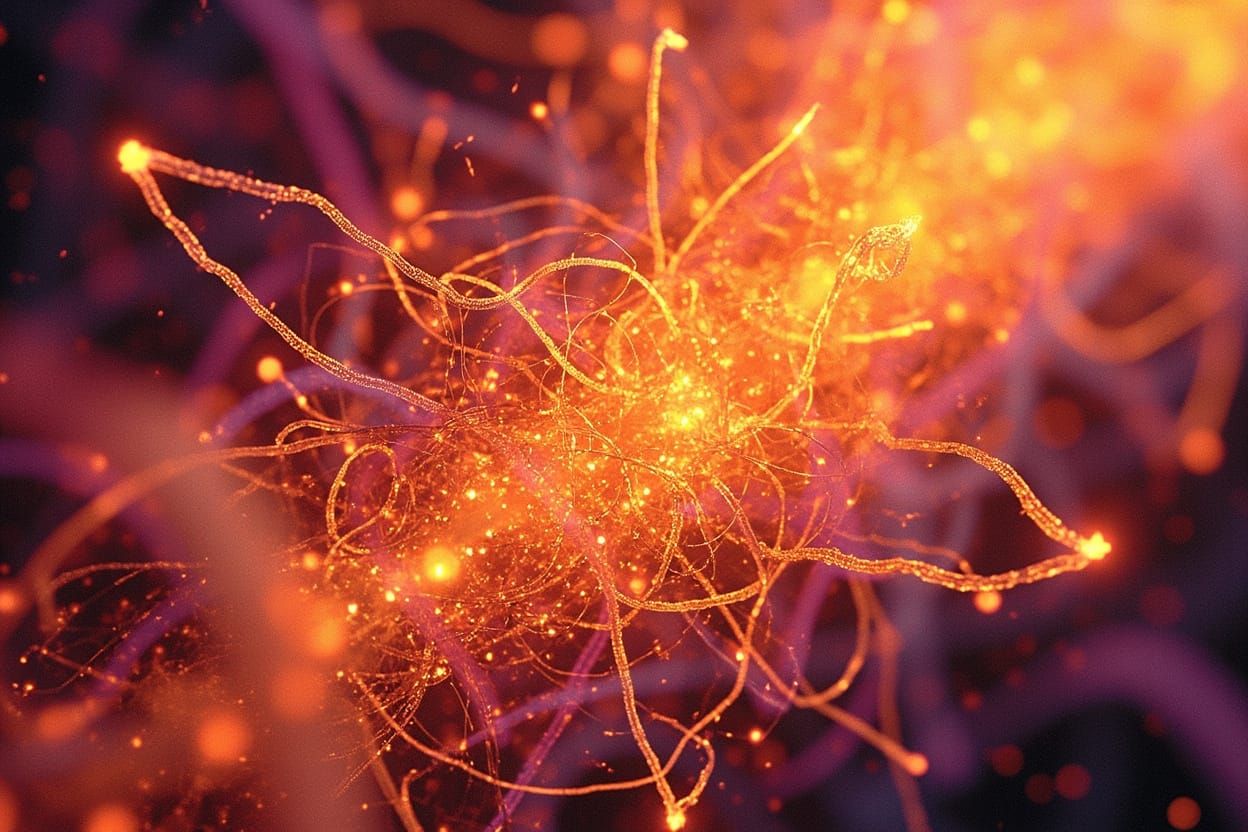
There — in all directions — the threads. Not visible to anyone without Weaver-sight, but she had stopped thinking of them as invisible decades ago. They were simply there, gossamer filaments of quantum entanglement connecting Kira to everything in the system: the gas giant it orbited, the inner planets, the outer anchors. Each thread had its own tension, its own texture. Healthy ones hummed. Stressed ones groaned. The ones connecting Kira to Sorvah's territory on the outer edge had been thinning for years — a slow degradation that no one had been able to explain.
She found the thinning one and reached for it.
Flickered.
Not weakened — flickered. Like a candle in a draft. The sensation was so unexpected that Mira jerked backward, her physical body stumbling on the crystalline shore, her Weaver-sense reeling with alarm.
The thread steadied. She reached for it again, more carefully. It resisted — not in the way a damaged thread resisted, but in the way something aware resisted. As if it knew she was touching it. As if it was choosing to let her.
That was not possible.
Tethers didn't resist. They were quantum phenomena, not conscious agents. They degraded, yes. They snapped under stress, yes. But they didn't choose.
Mira stood on the crystalline shore, salt wind in her hair, and felt the Star-Tree at the center of the system pulsing at the edge of her perception — the Old Breath, the slow collapse and expansion cycle that had been the heartbeat of the system since before recorded history. It had been irregular since she was a child, or since she had been a child, or since she had been whatever she was before she woke up connected to three hundred thousand dreams. The irregularity was normal. The Star-Tree was dying; everyone knew that.
But the flickering on the Sorvah thread — that had not felt normal. That had felt like someone listening.
The courier beacon arrived at sunset, which was the only time the old systems still worked reliably — something about solar interference patterns that no one had ever bothered to fix because fixing it would mean admitting the beacon system was obsolete and no one was ready to admit that yet.
The beacon was ancient. That was the first thing Mira noticed. It was a physical vessel, barely the size of her fist, tumbling through space on a trajectory that predated the current Treaty by centuries. It had been launched from somewhere outside the system — no civilization in the anchored bodies still used physical couriers — and it had arrived at Kira with no explanation and no sender identification.
Inside, wrapped in centuries of quantum decay, was a single voice recording. Mira activated it with a touch.
The voice was degraded, broken into fragments by the decay of the medium, but some words came through.
"...Binding was not..."
Static.
"...a contract. It was..."
Static. Longer this time. Mira leaned closer, her breath held.
"...a severance."
The recording ended.
Mira sat in the dark of her quarters, the beacon silent in her palm, and felt the Tethers humming around her — all of them, everywhere, the web she had been born into without consent, the web she had been maintaining without respite, the web that was supposed to be immutable, fundamental, the fixed architecture of reality.
The Binding was not a contract. It was a severance.
She recognized the voice. Not consciously — no one had spoken like that in recorded history, with that particular resonance, that particular weight in the low frequencies. But something in the Tether-structure of the recording resonated with her body the way a tuning fork resonates with the air around it. As if her body already knew what her mind was still struggling to understand.
She filed the message. She told no one.
That night, she dreamed of a star that was trying to remember its own name.
In the morning, the Dreamers sent another message: the unusual surge had resolved. The three hundred anxious dreamers had slept peacefully through the night.
Mira did not sleep at all.
She stood at her window — her real window, not a screen, because Weaver quarters had real windows, because you needed to be able to see the sky when you were holding it — and watched the Star-Tree rise over Kira's curve. Its corona flickered in a pattern she had never seen before. Or perhaps a pattern she had seen a thousand times and never thought to notice.
The Old Breath was changing.
Kira shifted beneath her feet — not physically, not yet, but in the way Mira felt it, the way the moon's quantum substrate hummed with new tension. Something was pulling at her world. Something had been pulling for a long time, and she had been too busy holding threads to feel it.
She hadn't told anyone about the drift. The slow fraction-of-a-degree shift that her instruments had been measuring for the past decade. It wasn't visible to anyone who wasn't a Weaver. It wasn't even visible to most Weavers — Kael, in the outer system, was too far away to feel it. Sorvah had other concerns. Dren didn't pay attention to inner-system politics.
It was her drift. Her problem. Her failure.
And now a message from outside the system, arriving without explanation, containing words that changed everything.
Mira pressed her hand against the cold glass and watched the dying star breathe, and wondered what it was trying to say.
The Weight of Threads ends with the Star-Tree flickering in a pattern that has no name, visible even from Kira's distance — its corona pulsing in slow, labored rhythm, the Old Breath becoming something uncertain.
Something is waking up. Something has always been waking up.
The threads are not holding as well as they used to.