

A Story of Mystery and Wonder
The old farmhouse had stood for one hundred and forty-seven years on the plains of rural Montana, and in all that time, Eleanor Vance had never seen anything like what happened on the night of September 15th.
It started like any other autumn evening. Eleanor, seventy-three years old and as stubborn as the prairie wind, sat in her rocking chair by the window, knitting a sweater for her granddaughter. The radio played softly—some talk show about cattle prices—and the wind outside whispered through the dry grass like a gently exhaled breath.
Then the lightning came.
But this was no ordinary lightning. The sky didn't flash and crack with the violent electricity of a summer storm. Instead, something descended from the clouds—something that moved with unnatural grace, something that seemed almost alive.
Eleanor set down her knitting needles. Her arthritic fingers trembled as she pressed them against the cold glass.
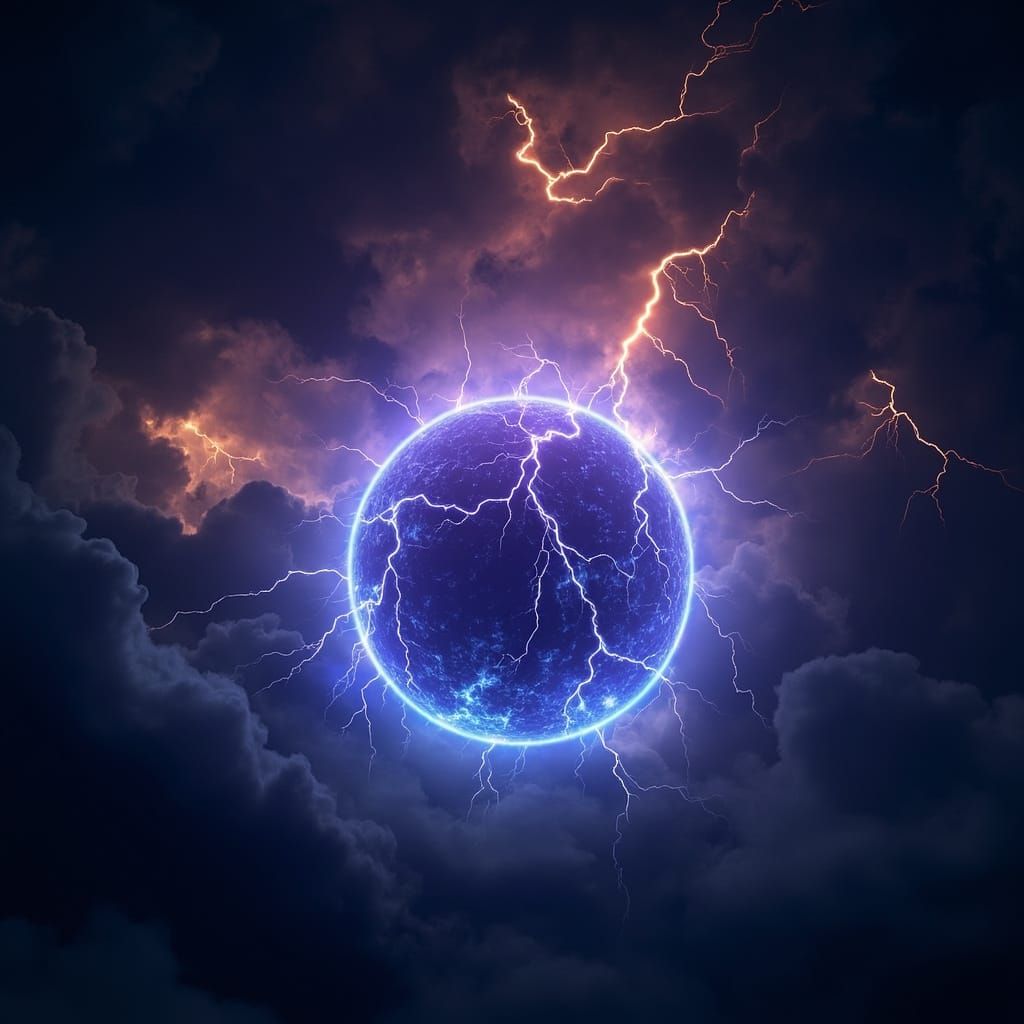
A sphere of light floated down from the heavens.
It was perhaps two feet in diameter, though in the darkness, it was hard to tell exactly. The glow was soft, almost gentle—a pale blue-white luminescence that reminded her of the way moonlight looks on fresh snow. But this light didn't illuminate the world like moonlight. Instead, it seemed to exist in its own space, its own reality, casting the world in shadows that didn't quite match its shape.
The sphere drifted through her yard like a balloon caught in a lazy breeze. It moved slowly, deliberately, as if exploring. As if curious.
Eleanor held her breath. She'd heard stories about ball lightning all her life—her grandmother had spoken of it in hushed tones, calling it "the ghost of the storm." But she'd never believed. How could anyone believe in something so fantastical?
Yet here it was, floating past her chicken coop, moving through the wooden fence as if the solid boards were nothing but morning mist.
The world seemed to hold still. Even the wind had died. The only sound was the soft crackle of the sphere itself—a sound like static electricity, like the universe itself was humming.
Then it changed direction.
The sphere drifted toward her window. Toward her.
Eleanor's heart hammered against her ribs. Every instinct told her to run, to hide, to flee from this impossible thing. But her body wouldn't move. She could only watch as the ball of light approached, growing larger, growing brighter, filling her small kitchen with its ethereal glow.
At the last moment, it stopped. It hovered just outside her window, close enough that she could see the way the light danced and swirled within it—like countless tiny lightning bugs trapped in an impossible jar. Like stars being born and dying in an eternal moment.
And then, impossibly, it spoke.
Not in words. Not in sounds that her ears could hear. But somehow, Eleanor understood. The message arrived in her mind like a dream—vivid, clear, and completely inexplicable.
"We are not what you fear. We are what you hope."
The sphere pulsed once, twice, three times. Then it drifted upward, rising toward the stars from which it had come. Eleanor watched it go, watched until it vanished into the darkness above, leaving only the memory of its light and the message that would change her life.
The scientists came three days later.
They'd heard about the incident from neighbors, from the unusual readings on their instruments, from the whispers that spread through small towns like wildfire. A team from MIT arrived in a convoy of black SUVs, their equipment glinting in the morning sun.
Dr. Sarah Chen was lead researcher—a woman who had devoted her career to studying atmospheric phenomena. She'd investigated ball lightning reports from around the world, had interviewed hundreds of witnesses, had spent countless hours in remote locations waiting for a glimpse of the impossible.
But she'd never actually seen it. None of them had.
"You're sure it was ball lightning?" Dr. Chen asked, her notebook ready, her voice carefully neutral.
Eleanor nodded. "I've read about it. This was something else. Something... conscious."
The scientists exchanged glances. They'd heard such claims before—witnesses who insisted their encounters were more than mere natural phenomena, who spoke of messages and meaning in their experiences.
But then they saw the data.
The instruments they'd set up in Eleanor's field had recorded something extraordinary. During the event, the local electromagnetic field had fluctuated in patterns that matched nothing in their databases. The atmospheric composition had shifted in ways that shouldn't have been possible. And there, buried in the data, was a signal—a series of pulses that repeated in a pattern too precise to be natural.
"It's a code," Dr. Chen whispered, her face pale with wonder. "The electromagnetic pulses— they're encoding information."
The team worked for weeks, analyzing the data, running simulations, searching for explanations. What they found defied everything they knew.
The code, when decrypted, contained mathematical sequences—prime numbers, geometric ratios, the fundamental constants of physics. It was as if the ball lightning had been sending a message, a demonstration of intelligence, a proof that it was not merely a random atmospheric phenomenon.
But proof of what? And from whom?
Eleanor never learned the full answer. The scientists never published their findings—the data was classified, the research was buried, and Eleanor was asked (politely but firmly) to keep quiet about what she'd seen.
But she didn't keep quiet. Not because she disobeyed the scientists, but because she'd already shared her story—with the only audience that mattered to her.
Her granddaughter, Maya, had come to visit after hearing about the incident. She'd sat at Eleanor's kitchen table, drinking tea, listening as the old woman told her story.
"Grandma," Maya had asked at the end, "do you think it was aliens?"
Eleanor had smiled—that slow, knowing smile that came from seven decades of living.
"I don't know what it was, sweetheart. But I know what it meant. 'We are not what you fear. We are what you hope.' That's what it told me."
"What do you think it meant?"
Eleanor had looked out the window, at the fields where the strange encounter had taken place, at the sky that now seemed different than it had before.
"I think," she'd said slowly, "it meant that not everything from the heavens is here to destroy us. Sometimes, something comes from above just to remind us that we're not alone. That the universe isn't as cold and indifferent as we think."
Years passed. Eleanor passed too, in her sleep, at the age of eighty-nine, with Maya holding her hand.
But her story lived on.
Maya became a scientist—a physicist specializing in atmospheric phenomena, following in the footsteps of Dr. Chen. She dedicated her career to studying ball lightning, to searching for more encounters, more signals, more evidence that her grandmother's experience was real.
And sometimes, late at night, when she was alone in remote observatories, waiting for storms to roll in, she would think about that message.
We are not what you fear. We are what you hope.
It had become her motto, her guiding principle, her answer to everyone who asked why she did what she did. Because the universe was stranger and more wonderful than anyone knew. Because somewhere, something was waiting to be discovered. Because hope was always worth pursuing, even when—perhaps especially when—it came from the most impossible places.
The night the sky came down taught Eleanor something that she passed on to her granddaughter, and that Maya now passed on to a new generation of scientists:
Not all mysteries are meant to be solved. Some are meant to be lived.
And in the living, we find wonder.
Somewhere in the Montana sky, on storm-filled nights, the ball lightning still dances. Still watches. Still waits. Still hoping that someday, someone will understand the message.
We are not what you fear.
We are what you hope.