

A Story of the First Personalized Gene-Editing Therapy
Nicole Muldoon had been awake for thirty-seven hours when the neonatologist appeared in the doorway of her hospital room. She knew the shape of that face before she even registered his features — the particular set of the jaw that meant something was wrong, had been wrong, and they were just now telling her.
"The ammonia levels are elevated," he said. "We're transferring your son to CHOP."
KJ was thirty-six hours old.
In the ambulance, sirens screaming through Philadelphia pre-dawn, Nicole held her husband's hand and watched the monitors flash numbers she didn't understand. Kyle's face was pale in the emergency lights. Neither of them had slept since the delivery — not really slept, not the way you sleep when a baby is finally in your arms and the world makes sense.
The doctors had used words like rare and severe and urea cycle disorder. They had explained that KJ's liver was missing an enzyme that most people take for granted, the one that converts ammonia — a byproduct of protein breakdown — into something the body could excrete. Without it, ammonia would build up in his blood like a slow poison, damaging his brain and liver by degrees.
The survival rate for neonatal-onset CPS1 deficiency was about fifty percent.
"We would do anything for our kids," Nicole had said, somewhere in the blur of those first hours. She hadn't known yet how literally she would mean those words.
At Children's Hospital of Philadelphia, KJ was admitted to the neonatal intensive care unit. The doctors put him on a severely restricted protein diet and began a regimen of medications designed to scavenge what ammonia they could. It was bridge medicine — the kind designed to keep a patient alive long enough to find something better.
Dr. Rebecca Ahrens-Nicklas was the director of the Gene Therapy for Inherited Metabolic Disorders Frontier Program at CHOP. She had spent her career studying exactly these kinds of rare, devastating diseases — the ones that killed children before they had a chance to become children. She had also been watching the development of CRISPR gene-editing technology with the particular hunger of someone who sees a tool that could finally do what no drug could.
Her collaborator, Dr. Kiran Musunuru at the University of Pennsylvania, had been building a platform for personalized gene editing — not the one-size-fits-all approach that had worked for sickle cell disease, but something more ambitious: a way to design a treatment for one person, customized to their exact genetic mutation, delivered in months instead of years.
When KJ arrived at CHOP, Rebecca saw the shape of the moment she had been waiting for.
"We can do this," she told the team. "We can build a drug for this baby."
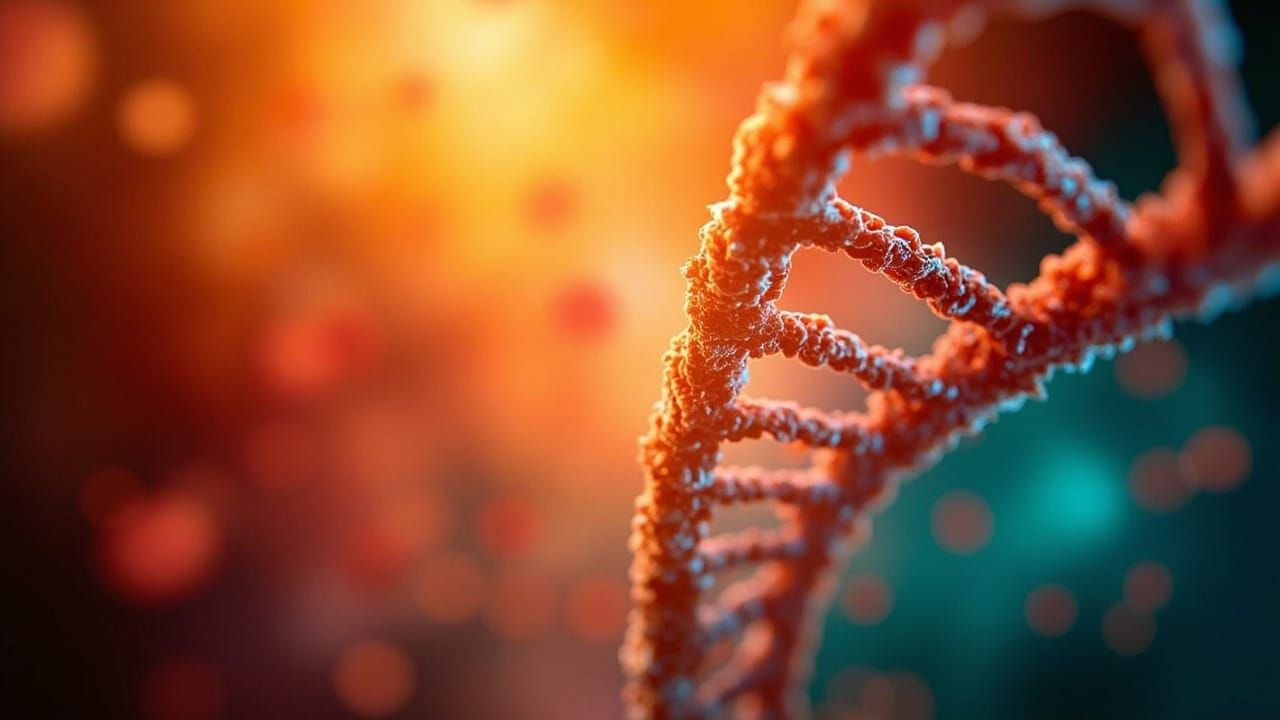
The science of base editing is quietly miraculous. Traditional CRISPR systems work like molecular scissors — they cut both strands of the DNA double helix and hope the cell's repair machinery fixes the break correctly. Base editors are different. They don't cut. They chemically convert one DNA letter into another, like changing a single letter in a word without erasing the word itself. It's more precise, more controlled, less likely to cause the kind of off-target mutations that can turn a treatment into a new disease.
For KJ, the team identified the exact single-letter mutation in his CPS1 gene that was causing his liver to fail. They designed a base editor that would correct that letter. Then they packaged it in lipid nanoparticles — tiny fat bubbles that, when infused into the bloodstream, would travel to the liver and deliver the editor directly into his liver cells.
The question was whether it would work. The question was also whether it would kill him.
There had never been a human trial of a fully personalized gene-editing therapy. There had never been a protocol. The FDA had never seen an application quite like this one — a drug built for a single patient, designed in a laboratory, manufactured in months, with no safety data in humans because no human had ever received this exact treatment before.
They called him Patient Eta in the documents. In the hospital, he was KJ.
Nicole and Kyle signed the consent forms on a Tuesday morning. The papers were thick with warnings and unknowns. They were asking their son — who was not yet seven months old — to be the first human being on Earth to receive a treatment designed entirely for him.
"We would do anything," Nicole said again, and this time it felt like a prayer.
The first infusion went into KJ on a cold February afternoon. Rebecca watched the monitors with her whole body tense, waiting for the fever that would mean immune rejection, the seizure that would mean brain damage, the silence that would mean they had gambled and lost.
Nothing happened.
KJ slept. His vitals stayed steady. The base editor went into his liver cells and began correcting the mutation, one letter at a time, in a fraction of his liver mass. The scientists had estimated they would need to edit somewhere between ten and thirty percent of his liver cells to give him a meaningful benefit. The early data suggested they were hitting that threshold.
The second infusion came in March. The third in April.
By May, KJ was home.
The doctors called it a transformation. The severe neonatal-onset disease had become something much milder — not a cure, exactly, but a fundamental reprieve. KJ could tolerate increased dietary protein. He could recover from ordinary childhood illnesses like rhinovirus without dangerous ammonia spikes. He was learning to catch and throw a ball. He took his first steps before Christmas.
"He is thriving," Nicole told the reporters who had gathered to cover the milestone. "He's just — he's a little boy. He's just being a little boy."
The researchers published their results in the New England Journal of Medicine. They called it a proof of concept — evidence that personalized gene editing was not just theoretical but practical, not just possible but effective. The NIH added KJ to their list of landmark achievements. Nature named him one of their "Nature's 10" — the people who shaped science that year, the ones whose stories would be told and retold as the field moved forward.
But the researchers also talked about what came next. The platform they had built, the pipeline they had proven — that was the real story. For every child like KJ, there were dozens, hundreds, thousands of children with different rare mutations, different genetic errors, different urgent needs. If they could build a drug for one patient in six months, they could scale the approach. They could push it outward.
They could, they hoped, make this kind of medicine available to everyone who needed it.
But the story has another chapter, and it's harder to tell.
The first personalized gene-editing therapies are estimated to cost two million dollars per patient. Maybe more. The manufacturing is complex, the regulatory pathway is unprecedented, and the economics of one-off drugs are brutal in ways that everyday medications are not. A drug for one person requires all the research, all the testing, all the oversight of a drug for millions — but it only gets sold once.
The families who have watched KJ's story from the outside understand the stakes better than anyone. Their children have rare diseases too. Their children need help too. But the math of personalized medicine doesn't work for them yet, and may not work for a long time.
"We would do anything," those parents say, and they mean it. But "anything" is a word that has limits when the price tag is a number with commas you can't count.
KJ will be monitored for the rest of his life. The scientists will track his liver function, his neurological development, his long-term outcomes. They will watch for late effects, for unexpected consequences, for the ways that changing a single letter in a genome might ripple outward in directions they can't predict.
But for now, he is a toddler who catches a ball and takes steps and laughs at things that are funny to toddlers. For now, he is a boy named KJ, not a patient code, not a medical milestone.
For now, he is just being a little boy.
And his parents — who said they would do anything, and meant it, and did it — watch him grow and try not to think about the families who are still waiting for someone to say the same words to them.
The first personalized gene-editing therapy was a success. A baby was saved. A new door opened in medicine.
And somewhere in the space between that door and the world that needs it, the hardest questions are still being asked — about who gets through, and who waits, and what it means to build a future where the answer to a fatal disease is not a question of science but a question of money.
The scientists are working on that too. They say the costs will come down. They say the pipeline will scale. They say this is just the beginning.
For KJ, the beginning is already enough.
This story is based on the first personalized CRISPR gene-editing therapy, performed in 2025 at Children's Hospital of Philadelphia on KJ Muldoon, a baby born with severe CPS1 deficiency. The treatment was developed by Dr. Rebecca Ahrens-Nicklas and Dr. Kiran Musunuru. For more information, see the research document in this vault.