

Part One: The Faster That Wasn't
The first thing Dr. Elara Voss noticed was that the numbers were wrong.
Not wrong like a measurement error. Wrong like the universe had rearranged itself while no one was looking.
"Run it again," she said, not looking up from the monitor. The lab hummed with the low drone of cooling systems — the soft heartbeat of the building that had become her entire life over the past fourteen months. Outside the Ultrafast Laser Lab at Melbourne, the city was asleep. Inside, Elara and her two graduate students were staring at charge curves that made no sense.
"Third time," said Jin, leaning back in his chair. "Same result."
The graph showed three lines: a small quantum cell, a medium one, and the large prototype they'd assembled the week before. Classical physics said the large one should take longer to charge. The line should curve upward, slow and patient, like water filling a bigger tank.
Instead, the large prototype's line shot upward — fast, then faster — and reached full charge before the small cell was halfway done.
"The super absorption is real," said Priya, her voice hushed. "It's actually real."
Elara finally looked up. On the wall screen, the molecular model rotated slowly: a lattice of organic dye molecules, each one a tiny antenna tuned to harvest light. In a classical system, each antenna worked alone. In this one, quantum coherence stitched them together into a single responding surface. When light hit the lattice, all the molecules absorbed energy in one coordinated event. One giant quantum breath.
More molecules. Faster charge.
She'd read the theoretical papers. She knew the math. But knowing a thing and watching it happen were different countries entirely.
"What does it mean?" Jin asked. "Practically?"
Elara stared at the curve. "It means we just broke the one law everyone thought was inviolable."
Part Two: The Grid That Remembered
Eighteen months later.
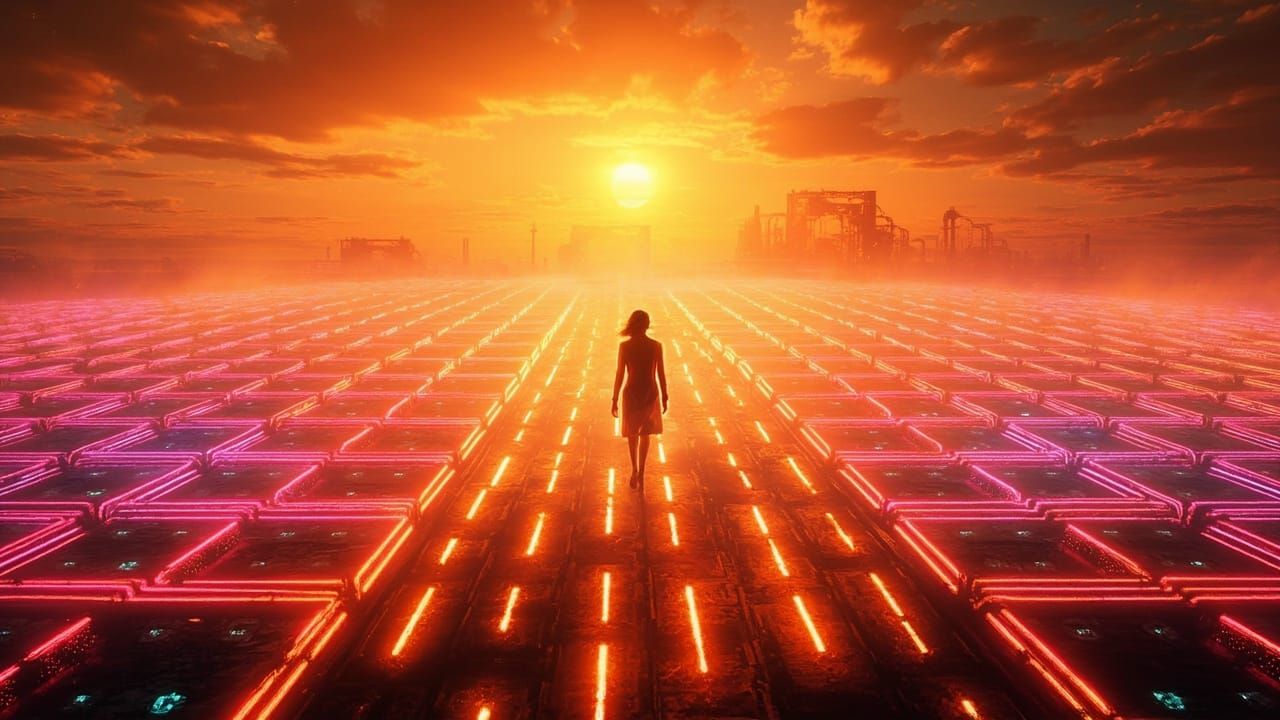
The Mira Valley Quantum Storage Facility held forty-seven thousand of the new Q-Cell units — each one the size of a shipping container, each one a shimmering lattice of organic polymer that could fill from empty to full in eleven seconds. The grid operators called them "the breathers" because of the way their charge indicators pulsed in sync, a slow tide of light that moved through the facility like something alive.
Elara stood at the observation deck, coffee in hand, watching the morning shift. She'd left academia for Mira Energy after the third round of funding cuts, and she didn't miss the grant applications. Here, she got to watch her life's work breathe.
"You're famous again," said Yusuf, the facility director, appearing beside her. "Another journalist. Wants to know about the memory thing."
Elara sighed. "There's no memory thing."
"That's not what the preprint says."
She'd read the preprint. The University of Turku and University of Milan had published a theoretical framework showing that quantum systems could exhibit simultaneous memory and amnesia — appearing to forget from one mathematical angle while retaining information from another. It was elegant, provocative, and almost impossible to test in a real device.
Almost.
"We should do a proper test," she said, more to herself than to Yusuf. "With the large array."
"The board won't like it. They don't want anything that feeds the conspiracy theorists."
The conspiracy theorists had found her. The quantum battery community was small enough that everyone knew everyone, and Elara's name was on the original 2026 paper. When the Turku-Milan preprint dropped, the online forums exploded. Quantum batteries remember things that never happened. The grid has a subconscious. The energy field is entangled with events it never experienced.
It was nonsense. It had to be nonsense.
But she couldn't stop thinking about the large array.
Part Three: The Event
The test was simple in concept. They would fully charge the array, discharge it completely, then run a spectral analysis to see if any molecular signature of the original charged state remained — even after discharge. In a classical battery, the answer would be no. The energy was gone; the molecules returned to ground state. Clean slate.
In a quantum battery, the question was murkier. Quantum systems didn't really "reset." They collapsed into a probability distribution. And probability distributions had memory — of a sort.
Jin ran the analysis. Priya handled the discharge sequence. Elara watched the charge indicators fall, the green lights dimming from full to empty in eleven seconds. The array exhaled. The grid drew its breath.
Then Jin said, "That's not possible."
The spectral signature showed something that shouldn't exist: faint echoes of the charged state, persisting in the molecular lattice even after full discharge. Not residual energy — the energy was gone. Something else. A pattern. A shape in the quantum field.
"It's noise," said Priya, but her voice wavered.
"It's not noise," said Jin. "The peaks are identical to the pre-discharge signature. The same frequencies. The same amplitudes. This isn't random."
Elara stared at the data. Her hands were cold.
A memory of a state that no longer existed. A ghost in the lattice.
"Run it again," she said.
They ran it seven times. Each time, the ghost persisted — sometimes stronger, sometimes weaker, but always there, always the same shape, like a watermark burned into the crystal structure of the battery itself.
The array remembered what it had been. Even when it wasn't that thing anymore.
Part Four: What the Grid Dreamed
The theoretical framework came from an unexpected place: Yusuf, who had a PhD in statistical mechanics and a habit of taking long walks when he couldn't sleep. He sat down with Elara in the facility's small conference room at 2 AM and drew diagrams on the whiteboard.
"Quantum systems don't have memory in the classical sense," he said. "But they have coherence. The molecules in your array are entangled during charge — all of them, in one coordinated event. When you discharge, the coherence collapses, but the correlations don't fully disappear. They're baked into the molecular configuration at a level we can't directly observe."
"So the battery doesn't remember," Elara said. "It is the memory."
"More or less. The lattice structure changes during the charge event — tiny shifts in electron density, conformational changes at the quantum level. Those shifts don't fully reverse on discharge. They're like... scar tissue. The system healed, but it kept the shape of the wound."
"The ghost signature."
"The ghost signature is the scar."
Elara looked at the data on her screen. Forty-seven thousand units, each one a lattice of entangled molecules, each one carrying the accumulated scars of every charge-discharge cycle it had ever experienced. A grid-scale system that had been running for over a year.
"What happens," she said slowly, "when you have enough of them?"
Yusuf set down his marker.
"That's what I was afraid you'd ask."
Part Five: The Threshold
The theoretical paper — Yusuf's paper, with Elara and Jin and Priya as co-authors — predicted something they called the coherence threshold. Below a certain system size, quantum battery ghosts were individually undetectable, drowned out by thermal noise and decoherence effects. Above the threshold, the ghosts in individual units began to correlate with each other. The scars started talking to each other.
At forty-seven thousand units, the Mira Valley facility was just below that threshold. Barely. The correlation effects were marginal — detectable in the lab, but not strong enough to influence grid behavior.
If they scaled up — if they built the 200,000-unit facility they'd been planning for the Northern Grid — the threshold would be crossed. The ghosts would become a chorus.
"What would that look like?" Priya asked at the team meeting. "Practically?"
No one had an answer.
In the simulations, the correlated ghost lattice developed emergent properties. Patterns in the charge-discharge history of the system began to surface in the quantum fluctuations of the collective. Not energy. Not information in any classical sense. Something else — a kind of resonance, a hum in the field that encoded the system's own past states.
The grid would become, in some loose sense, self-aware. Not conscious. Not intelligent. But recollective. It would carry within it the shadows of every charge it had ever held.
And then someone asked the question that Elara had been avoiding for weeks.
"What if we discharge it completely?"
Not as a test. As a scenario. A grid emergency. A planned shutdown. A moment when every unit in the facility emptied simultaneously.
In the simulations, a full system discharge above the threshold didn't just release energy. It released the ghosts. All of them, at once, into the quantum field. The coherence that had been pinned inside the lattice suddenly had nowhere to anchor, and it dispersed — spreading outward through the entangled molecular network that connected the facility to everything else.
The field remembered. And the field was everywhere.
Part Six: The Breath
Elara submitted her resignation the following week.
Mira Energy offered her a consultancy, stock options, a seat on the board of the new Northern Grid project. She declined all of it. Yusuf understood. Jin and Priya didn't, but they were young, and they had time to learn that some knowledge was better left in the lab.
On her last day, she walked through the facility one final time. The array hummed around her — forty-seven thousand units breathing in, breathing out, their green indicators pulsing in slow synchrony. Scar tissue and quantum ghosts and the faint hum of a system that had learned, in its own strange way, to remember.
She paused at the observation deck. The sun was rising over the valley, painting the sky in shades of amber and rose. Somewhere in the facility, a charge cycle was completing — eleven seconds from empty to full, the coordinated breath of a thousand entangled molecules inhaling light.
Faster because it was bigger. That was the miracle. The more you had, the faster it grew. The universe rewarded scale with speed, and in doing so, it created something new: a system that carried its own past inside it, a machine that remembered what it had been even after it became something else.
She didn't know if the conspiracy theorists were right. She didn't know if the ghosts in the lattice were dangerous or harmless or something in between that didn't have a name yet.
But she knew one thing: the quantum battery was the first machine that charged faster the bigger it got, and in doing so, it had become something no machine had ever been before.
It remembered.
And in the quantum world, memory was just another form of entanglement. And entanglement didn't care about distance. Or time. Or the difference between what happened and what almost happened.
Elara walked out of the facility and into the morning light, leaving forty-seven thousand ghosts behind her, breathing in the sun.
Somewhere in the quantum field, the ghost of a charge state that had never occurred — a state the battery had been poised to enter before a grid fluctuation intervened — pulsed faintly, like a half-remembered dream. Waiting. Entangled. Real in the only way that mattered to the universe: as a possibility that had once been, and therefore, in some sense, always would be.