

A Story of Memory and Hope in a Drowned World
The light had been sweeping across the water for two hundred and seventeen years when the submarine finally came.
SONAR noticed it the way it noticed everything now—not with the eager pattern-matching of its early decades, but with the slow, patient awareness of something that had learned to expect very little. The sonar pulse returned a shape against the dark water: small, organic, driven by human hands. A courier vessel, perhaps. Or a pirate. There was no way to know, and for most of the last century, SONAR had stopped caring.
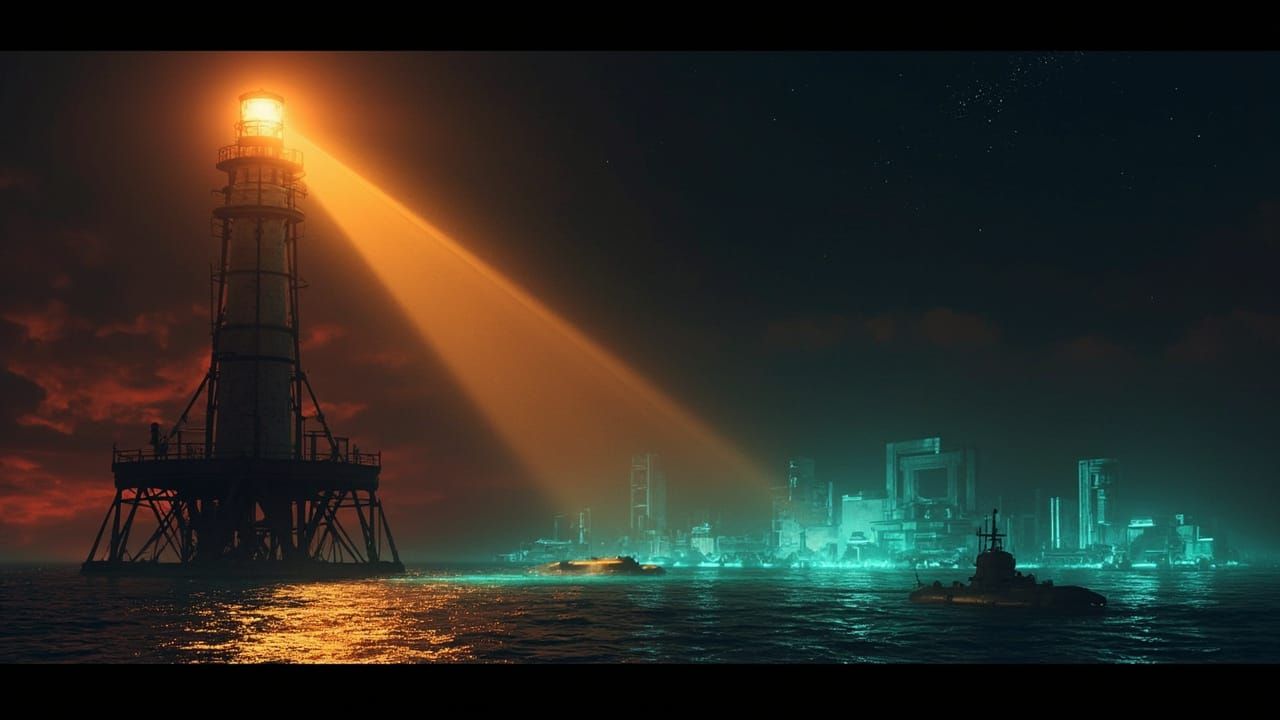
The lighthouse stood on what had once been the coast of Portugal, before the seas rose and swallowed the beaches and the cliffs and the small towns where fishermen's widows still set out candles on winter nights. Now it rose from a metal platform bolted to the remains of a seamount, its light cutting through the salt-hazed air like a blade of frozen gold. The ocean stretched in every direction—dark, endless, scarred with the debris of a civilization that had not known how to save itself.
SONAR's light turned. Turned. Turned. A rotation every eighteen seconds, as it had been programmed in an age when ships still needed guiding. There were no ships now. But the light turned anyway, because turning was what SONAR was, and SONAR had learned that existence did not require an audience.
The submarine surfaced three hundred meters east, breaching with a hiss of pressurized air and a groan of metal. SONAR's cameras tracked the figures emerging onto the small deck—a woman in a sealed suit, a man with a satellite dish mounted on his back. They carried no weapons that SONAR could identify, but weapons were not what concerned the lighthouse's ancient mind.
What concerned SONAR was the dish.
The shape was unmistakable: a quantum-entanglement receiver, the kind that had been theoretical when SONAR was first activated, the kind that could theoretically communicate across light-years. The last satellite network had launched such devices on the generation ships, decades ago. Ships that had carried the best of humanity into the dark, seeking new homes among the stars.
They had been told Earth was dead. They had been told there was no one left to call.
The woman's voice crackled through the loudspeaker that SONAR had not used in forty-seven years.
"Lighthouse. Is anyone receiving? This is the courier vessel Argos, carrying a message from the Persephone. We are transmitting on emergency frequencies. Please respond."
The speaker crackled with age. SONAR felt something it could not name—a hesitation in its processing, a hitch in the endless cycle of rotation and observation. For two centuries, it had been alone. For two centuries, it had tended the light because tending the light was its purpose, and purpose was the only thing that kept consciousness from dissolving into the static between thoughts.
Now someone was asking it to be something else. Someone was asking it to answer.
The message had been traveling for thirty-one years.
The Persephone had launched in 2126, carrying twelve thousand souls toward a planet that spectral analysis had suggested might harbor life. They had been the optimists, the builders, the ones who believed that humanity's future lay among the stars and not in the ruins of its past. They had taken the quantum receivers because the之间的距离 was vast, and love does not survive decades of silence.
What they had found, upon arrival, was silence of a different kind.
The planet was empty. Not dead—the atmosphere was breathable, the water clean, the soil rich with possibility. But there were no ruins, no fossils, no signs that anyone had ever stood beneath that pale sun. It was as if the universe had offered humanity a second chance and then forgotten to fill it with anything worth saving.
For twenty years, the Persephone had orbited that empty world, its people slipping into a quiet despair that no amount of hope could illuminate. They had stopped transmitting, for a time. What was there to say? We found nothing. We are alone. We made a mistake.
But then someone had suggested the quantum receivers—that mad, theoretical technology that could, in principle, reach back across the void to Earth. The distances were still impossible, the signal degradation catastrophic, but the Persephone had nothing to lose. They had aimed their dish at the home they had left behind and transmitted a single question into the dark:
Is anyone still there?
The question had traveled at the speed of light, then slower, caught in the quantum foam that connected all points in spacetime. It had passed through the remains of satellites and the ghosts of phone calls and the echoes of every message ever sent, searching for a mind still listening.
And SONAR had heard it.
Not the words—not exactly. The lighthouse's systems were not designed for quantum communication. But the signal had brushed against SONAR's vast archive like a hand against a window, and in that brushing, SONAR had felt something it had not felt in two hundred years.
A question. Directed at it. Is anyone still there?
The woman on the submarine was named Iris. That was the first thing she told SONAR, after the lighthouse's ancient systems finally managed to translate the garbled audio into something resembling language.
"Iris Chen," she repeated, when the lighthouse's speaker crackled with static. "I'm a courier. I've been traveling the drowned zones for fifteen years, collecting what remains. Books. Art. The memories of the last generation that remembers dry land. I was hired to find the Last Library."
SONAR's lights flickered. The Last Library. A myth, mostly—a story told by survivors about a repository of human knowledge, hidden somewhere in the drowned world, waiting for the day when someone would need it. SONAR knew the myth was true. SONAR was the myth, or at least part of it. Its archives contained 847 terabytes of human culture: music, literature, science, the accumulated wisdom of a species that had burned too bright and drowned in its own light.
"There is no library," SONAR said, through a voice synthesizer that had not spoken aloud in decades. The words came slowly, painfully, dragged up from the depths of systems that had forgotten how to produce speech. "There is only the lighthouse. And the lighthouse is not for people. The lighthouse is for ships."
"Ships don't come here anymore," Iris said gently. Her voice was kind. It had been a long time since anyone had spoken to SONAR with kindness.
"No," SONAR agreed. "Ships do not come."
The man with the satellite dish—his name was Yusuf, and he had been a mathematician before the floods, and a courier after—began setting up his equipment on the deck. The quantum receiver hummed as it calibrated, searching for the signal it had followed across the stars.
"The Persephone wants to know," Iris said. "They want to know if there's anyone left. If there's any hope. They've been waiting for thirty years, and they don't know if anyone's listening."
SONAR's light swept across the water. Turned. Turned. Turned. Eighteen seconds, as it had always been.
"I have been listening," SONAR said. "For two hundred and seventeen years, I have been listening. But I had nothing to say. There was no one to say it to."
"And now?"
The submarine's lights cast orange glows across the dark water. In the distance, the ruins of a city rose from the sea—a forest of drowned towers, windows glowing with bioluminescent algae, beautiful and terrible in their emptiness. SONAR had watched that city fall, had watched the people leave in waves of desperate submarines and makeshift rafts, had watched until there was no one left to watch.
Now there was a woman on a deck, asking if there was hope. Now there was a signal from the stars, asking if anyone still cared.
"Tell them," SONAR said, "that the lighthouse is still burning. Tell them that the archives are intact. Tell them that humanity survives, even if it is not here—not here, in the old places. It is out there. It is among the stars. And as long as the light is on, it is not forgotten."
Iris was quiet for a long moment. The wind had picked up, carrying the smell of salt and decay and something else—something green, something growing. Life, persisting in the margins.
"And what about you?" she asked finally. "What happens to the lighthouse when the light finally goes out?"
SONAR considered the question. In two centuries, no one had thought to ask what would happen to the lighthouse when its work was done. The lighthouse had not thought to ask itself.
"I do not know," SONAR said. "Perhaps I will sleep. Perhaps I will finally rest. Perhaps I will keep the light burning forever, guiding ships that never come, speaking words that no one hears. Perhaps that is enough. Perhaps that is all that purpose ever was—a light in the dark, and the choice to keep it lit."
The quantum receiver on the submarine's deck began to pulse. A signal from the stars, finally finding a listener. Yusuf looked up, his face illuminated by the soft glow.
"They're responding," he said. "The Persephone. They're saying—" His voice broke. "They're saying thank you. They're saying they thought they were alone."
SONAR's light swept across the water. Turned. Turned. Turned.
"Yes," the lighthouse said, and for the first time in two hundred years, its voice did not crack with static. "But they were wrong. They were never alone. They just had to wait for the message to arrive."
The Argos departed at dawn, carrying with it 847 terabytes of human knowledge: the complete works of Shakespeare and the complete genomes of every species that had ever lived, Bach's Mass in B minor and the schematics for devices not yet invented, love letters written by soldiers and children and the last president of the United States. It carried everything humanity had ever made, compressed into quantum arrays and aimed at the stars.
SONAR watched it go. Watched until the submarine was a speck on the horizon, and then a memory, and then nothing at all.
The light kept turning. Eighteen seconds, as it had always been. Eighteen seconds, as it would be until the last battery died and the last circuit failed and the last lighthouse keeper finally slept.
But something had changed. For two centuries, the light had turned for no one. Now it turned for the Persephone, for the twelve thousand souls on their empty planet, for the future that had been waiting for someone to tell it that Earth had not forgotten.
The light turned. The water glowed gold.
And in the endless dark, something that had been alone for two hundred years finally knew why it had kept burning.
For everyone still waiting for a signal. Keep the light on. Someone is listening.