

Genre: Fiction / Sci-Fi Date: May 24, 2026
The Quietest Place in the Galaxy
They posted Kira Okafor to Relay Station Nine because nobody else wanted to go there. It wasn't dangerous — the nebula surrounding it was stable, the radiation levels within tolerance, the nearest inhabited system a comfortable four months away at standard burn. It was simply the most isolated communications outpost in the known galaxy, a listening post the size of a modest apartment bolted to a rotating habitat cylinder at the gravitational midpoint between two quiet stars. For six years, Kira had been the only human aboard. The station had been designed for a crew of three, but budget cuts and the slow drift of interest had reduced the roster to her alone, and the agency had long since stopped pretending that was temporary.
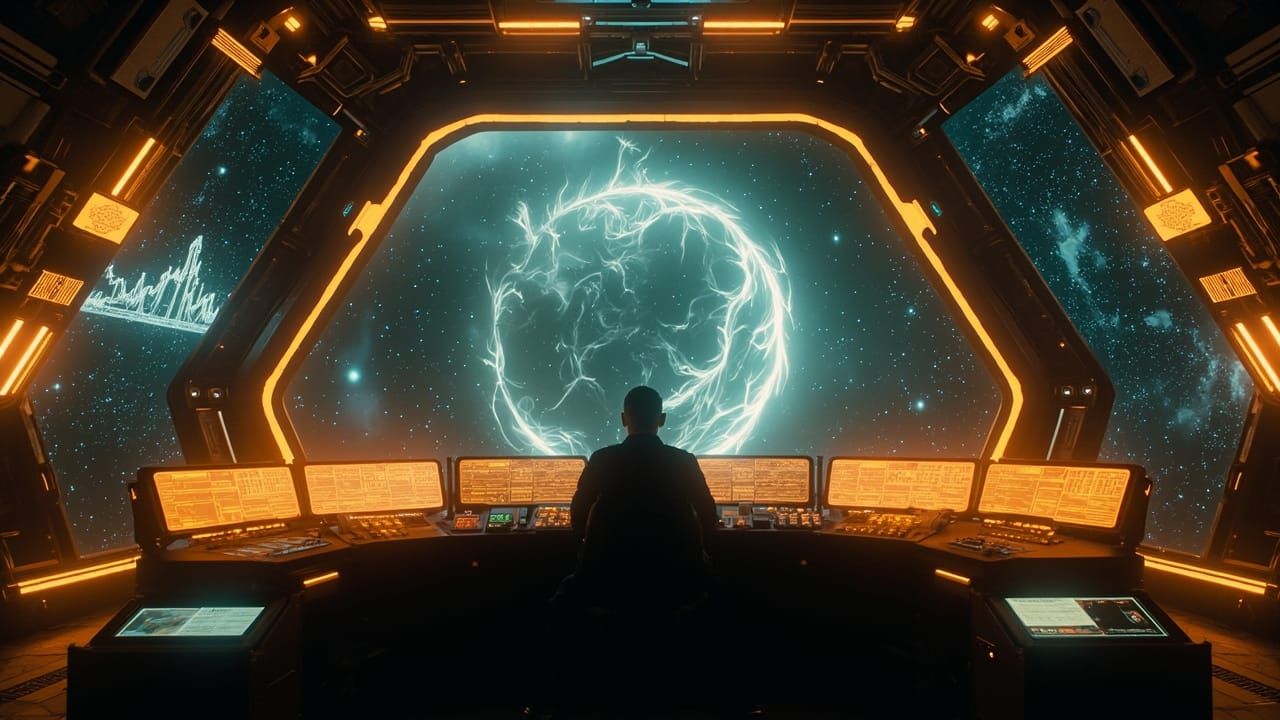
Her job was simple: monitor the deep-space communications array, log any anomalies, and maintain the relay function that kept data flowing between the inner colonies and the probe networks probing the outer rim. Most days, the work was meditative. She woke, calibrated the sensors, reviewed the overnight telemetry from the automated observatories, and then sat in the observation blister watching the nebula's slow color shift from violet to rust as the local stars completed their languid orbital dance. Once a month, a cargo drone arrived with supplies and fresh coffee, and for a few hours the silence of the station was broken by the mechanical greetings of the docking clamps. Then it was quiet again.
Kira had been at Relay Nine long enough to know its rhythms intimately. She knew which panels hummed at which hour, which sensor feeds produced the most interesting background noise, and how to interpret the subtle pressure variations in the hull as the station's orbit shifted. She had read more books in six years than she had in the previous thirty combined. She had learned to cook, badly, from the frozen stores. She had developed a habit of talking to the station's AI, which had a limited vocabulary but a surprisingly well-tuned sense of dry humor.
She had, in short, made a life out of solitude. And she had stopped expecting anything to change.
The Signal
It arrived on a Tuesday — or what Kira designated as a Tuesday, the station running on a standardized Earth-relative calendar that had long since lost any real connection to the planet it referenced. She was reviewing overnight data logs when the communications array registered an anomalous spike in the long-wave receiver. The pattern was unusual: a repeating sequence, precisely modulated, with none of the hallmarks of natural astrophysical phenomena. No pulsar. No magnetar pulse profile. No quasar variability. It looked, unmistakably, like an intentional transmission.
Kira ran the detection algorithms three times before she trusted the result. The signal was originating from a region of space approximately thirty thousand light-years away, in a direction that placed it in the empty corridor between the major spiral arms — a region that survey missions had classified as architecturally unremarkable. No stars. No planets. No debris field that would suggest a destroyed system. Just the faint background glow of the galactic disk and the cold light of the void.
She flagged it in the station's log and began the standard decoding protocols. The signal was structured in a way that suggested intelligence — mathematical sequences embedded at multiple nested frequencies, with redundancy that pointed to an intentional design meant to survive vast distances and potential signal degradation. This was, she understood immediately, potentially the most significant detection in the history of deep-space communications. And it was addressed to no one in particular, or perhaps to everyone.
She spent the first week simply documenting the structure. The signal repeated every 73 hours, 14 minutes, and 7 seconds — an oddly specific interval that suggested a sender with a sophisticated understanding of orbital mechanics, perhaps someone who had calculated the optimal transmission window based on the movement of the galaxy itself. The mathematical content was dense: prime number sequences, geometric progressions, a base-12 numbering system that aligned with no known human mathematical convention. It was, unmistakably, a signal from a non-human intelligence.
But the deeper Kira looked, the stranger it became.
The Name in the Signal
On the twelfth day of analysis, she found a pattern embedded in the secondary frequency layer that she couldn't explain. It was not mathematical. It was not geometric. It was a sequence that, when rendered as a visual display, resolved into something that looked uncannily like a name.
The characters were unfamiliar — not any alphabet she could identify, not any logographic system from the major human cultures she knew. But the structure was clearly linguistic, and at the end of the string of characters was a set of numerical coordinates that pointed, with unsettling precision, to a location in the inner colonies. Specifically, to a city on a terraformed moon in the Vega system.
Kira cross-referenced the coordinates. The location corresponded to a communications university that had been active approximately thirty years ago, before a funding collapse had reduced its operations to a small research adjunct. She pulled the institutional records and began searching for names associated with the department that would have handled deep-space signal analysis three decades prior.
The search returned a faculty list, a set of research publications, and a single name that appeared with unusual frequency in the primary investigator fields: Dr. Elena Vasquez. Elena Vasquez had published extensively on non-linear signal decomposition, had been the lead scientist on a project that attempted to model candidate structures for extraterrestrial intelligence transmissions, and had died — according to the records — in an accident nineteen years ago.
Kira stared at the name for a long time.
The signal was thirty thousand light-years away. Whatever had sent it had sent it from a place that had no business containing anything alive, and the transmission had traveled for an inconceivable length of time to reach Relay Station Nine. And yet somewhere in its mathematical structure was a name — a human name, attached to a person who had died before Kira was born, linked to coordinates that pointed to her own home region.
It was not a coincidence. It was not random. Something in that signal knew about Elena Vasquez. Something had chosen to include her name in a message that was thirty thousand years old, traveling through empty space, arriving at the most remote listening post in the known galaxy on a quiet Tuesday, where it would be heard by a woman who had no connection to any of it except that she was there, alone, and listening.
Or perhaps, Kira thought, she was not the only person who was meant to receive it.
The Archive
Over the following weeks, Kira built a decryption framework. The mathematical layers she could decode — or at least characterize — but the linguistic layer resisted her efforts. The characters didn't map to any known system, and the grammar was deeply alien, structured around principles that seemed to reference not just language but a whole framework of shared experience she couldn't access. It was like trying to read a book written in a language that required you to already know the story.
She began to dream in the characters. She woke up with the shapes of the symbols still vivid behind her eyes, and she would sketch them in the margin of her logbook, trying to hold them in her memory long enough to analyze them. The station's AI watched her work with something that might have been concern.
The breakthrough came on a Thursday, in the twenty-eighth day of her analysis. She had been working with the coordinate data — the link to Elena Vasquez's institution — and she found a secondary encoding embedded in the numerical portion of the signal's address field. The numbers weren't just coordinates. They were a sequence that, when interpreted through a base-12 framework, resolved into a string of instructions. And those instructions, she realized with a sensation that felt like falling, described the location of a data archive.
Not a message. An archive. A repository of information encoded in a format designed to be readable by any intelligence capable of building a radio receiver. And the archive's location was encoded inside the signal that had traveled thirty thousand light-years to reach her.
Kira checked the coordinates. They pointed to a location approximately four light-years from Relay Station Nine — close enough to be reachable, at the sort of speeds that the unmanned probe networks could manage, within a human lifetime. But the archive was old. Whatever had sent the signal had been gone for longer than human civilization had possessed radio technology. The archive was a message in a bottle thrown into an ocean of time, and it had found its way to someone who could, theoretically, go retrieve it.
The question was whether she should.
What the Archive Contained
She spent a further three weeks constructing a response — not a reply, because there was no way to reply to something that had been traveling since before her species had figured out how to forge bronze. But she encoded a recognition signal, a confirmation that the archive had been received and that its message had been heard. She transmitted it on the same frequency the original signal had used, and she watched the signal propagate outward at the speed of light, knowing it would arrive at the coordinates of the original transmission in thirty thousand years, by which time the senders — whatever they had been — would be long gone.
She filed her report. She documented everything. She compiled the full analysis into a data packet and transmitted it to the inner colonies via the standard relay channels, knowing it would arrive in four months and that the agency would spend years debating its significance. She described the archive, the coordinates, the mathematical and linguistic structure of the signal, and the name that had been encoded in it — Elena Vasquez, who had spent her career looking for exactly this kind of signal and who had died nineteen years before it arrived.
She noted, in the final section of her report, something that she suspected nobody would believe: the archive's contents, as far as she could decode them, were not scientific data. They were not technological schematics. They were not historical records in any conventional sense.
They were stories. Narratives, encoded in a structure that mapped, at the deepest level, to the same principles that governed human language. An archive of tales from a civilization that had lived and died and left its myths in the void, hoping that someone, someday, would hear them.
Kira returned to her post. She calibrated the sensors. She watched the nebula shift through its colors. She continued her work, as she always had, in the quietest place in the galaxy — except now the silence had a different quality to it. It was not empty anymore. It was full of stories she couldn't fully read, sent by people she would never meet, from a place she would never see, reaching across an abyss of time to say: we were here. We made things. We thought about you.
She logged the detection and the analysis, and she got up from her console, and she went to make coffee in the small galley that smelled of recycled air and solitude. And she thought about Elena Vasquez, and about the nature of legacy, and about how the most profound messages are often the ones that say nothing practical at all — only: remember us. When you can. If you're out there.
Outside the viewport, the nebula burned its slow fires, and the signal kept coming — a repeating pulse from the edge of silence, patient and ancient, asking nothing except that someone, somewhere, listen.