

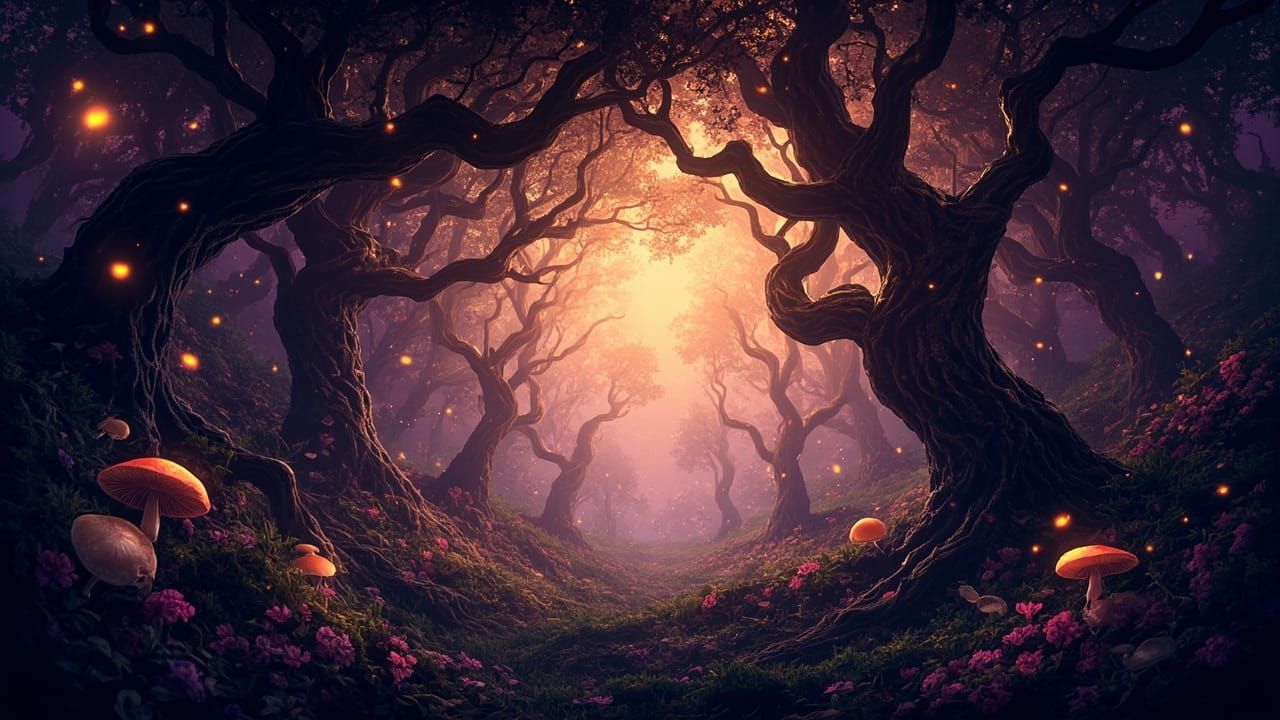
The Thornwood
The cartographer's guild kept no records of when the Thornwood first appeared on their maps. It simply always was—or so the senior mapmakers claimed, their faces blank as vellum when questioned. But Silas Wren had inherited Elnora Vance's private survey notes, and in those cramped margins, in handwriting that grew increasingly erratic near the end, was a different story entirely.
It was not here when I began, she had written. Now it will not leave.
The Thornwood occupied the eastern territories on every map Silas had ever seen of the region—a dense clutch of twisted trees rendered in careful crosshatching, its boundaries drawn with the same precision Elnora brought to all her work. But when Silas had walked those eastern roads as a young apprentice, there had been no forest. Only farmland, only the occasional orchard, only the soft rolling hills that made the eastern territories famous for their wool.
He had asked Elnora about it once. She had been old then, her hands trembling, her eyes sharp as a hawk's despite the fog of cataracts that had claimed most of her sight. She had looked at him for a long moment before answering.
"When I first came to this land, there was no Thornwood. I drew the eastern borders as the survey required. And then I drew a stand of trees because the land seemed too empty, too bare. I gave them thorns because I thought they looked lonely."
She had laughed then, but the sound was hollow.
"The next season, they were there."
Silas had assumed she was jesting. He assumed many things about Elnora Vance that he no longer assumed now, three years after her death, alone in the archive she had built, surrounded by maps of places both real and impossible.
The lantern flickered. Outside, the wind had picked up—the eastern wind that always preceded rain—and it rattled the shutters with an insistence that felt almost like knocking.
He turned back to his work. He had a new survey to complete, a commission from a landholder who wished to know the precise boundaries of his eastern property. The property abutted the Thornwood at its western edge, and Silas needed to determine whether the forest had expanded since Elnora's last survey.
He unrolled the survey map—the same one Elnora had used for forty years—and began to lay down his initial measurements. The Thornwood's edge, according to her notes, began precisely three leagues from the old mill at Harrow's Creek.
He marked the point. He measured the distance to the nearest stand of trees. He noted the species—blackthorn, mostly, with some hawthorn and a scattering of ash that had somehow survived the acidic soil.
And then, because the land was so empty, so bare, he began to sketch the unnamed groves he imagined might lie just beyond the boundary. He gave them shape. He gave them form. He gave them thorns.
The wind rattled the shutters again, more insistently now.
Silas dipped his pen and returned to his work.
The Bleeding Ink
He did not notice the change until he reached for his tea and found it cold, hours having passed without his awareness. The archive was dark save for the circle of lamplight around his desk, and the shadows seemed deeper than they should be, pooling in the corners like something that had gathered there on purpose.
He looked down at his survey map.
The ink had moved.
Not dramatically—not in the way of trick maps or carnival amusements. But the western branch of the Thornwood's creek, which he had drawn running northeast, now curved eastward and then south, and the grove he had sketched at the forest's heart had grown three times its original size, and there were new trees he did not remember drawing, clustered along the boundary line like sentries.
Silas stared at the map for a long moment.
Then he laughed, because what else was there to do? He had been working for hours; surely he had simply mapped differently than he remembered. The late hour had confused him. He had lost himself in the work, as he often did, and his hands had continued drawing after his mind had drifted.
He rolled up the map and set it aside. He would begin fresh in the morning.
But as he extinguished the lanterns and made his way to the small chamber behind the archive where he slept, he paused at the window. The eastern road was barely visible in the darkness, but he could see the treeline.
Or rather—he could see where the treeline had been, where it should have been, following the precise boundary drawn on every map in the guild's collection.
There was more.
Beyond the boundary, in the empty farmland that should have stretched to the horizon, there were shapes in the darkness. Shapes that moved slightly, that rustled, that seemed to lean toward the road like listeners.
Silas pulled the shutter closed.
He did not sleep well that night. He dreamed of a forest that did not exist—a forest of roots as thick as rivers, of thorns like metal, of trees whose bark was the color of old parchment. He dreamed that he walked those paths and that they rearranged themselves as he walked, that the forest was a creature with no eyes and no mouth but with an endless appetite for being seen, for being named.
"Why do you keep drawing me?" the forest asked, in a voice like rustling paper. "Why do you keep redrawing my edges?"
Silas woke with ink on his fingers, though he had not worked the night before.
Vera Marsh
The next morning, he went to see Vera Marsh.
Vera was not a cartographer. She was simply a woman who had lived in the eastern territories for ninety-three years, who was blind as stone, and who was rumored—if one believed the tavern talk of Harrow's Creek—to be able to see things that others could not.
Her cottage sat at the boundary line, or rather at what should have been the boundary line, with the Thornwood visible from her front door. She kept chickens and grew herbs in orderly rows, and she had a habit of laughing at things no one else found amusing.
"You're the new mapmaker," she said when Silas appeared at her gate. She had not needed to be told; she never did. "Elnora's replacement. I can smell the ink on you."
"I've come to ask about the Thornwood," Silas said. "The forest behind your cottage."
"Behind my cottage there is only woods," Vera said, still laughing that dry, papery laugh. "But the Thornwood is not merely woods. The Thornwood is a mouth that eats its own teeth."
"I don't understand."
"Of course you don't." She turned toward him, and her eyes—milky, sightless, ancient—seemed to look directly into his soul. "You cartographers never do. You think you make maps of things. But sometimes—" She paused, and the laughter stopped, and her voice dropped to something that was not quite a whisper. "Sometimes, the things are maps of you."
She asked him, then, who had taught him to draw. He told her about Elnora, and he watched her face change.
"Elnora," she repeated. "I remember Elnora. Forty years ago, I was young, she was middle-aged, and she came through here mapping the borders. She stood at the edge of the Thornwood—this was before it was the Thornwood, before she drew it into being—and she wept. She stood right here, where you're standing, and she said, 'I've made a terrible mistake. I've drawn something that shouldn't exist.'"
"And then what happened?"
"Then she drew it bigger." Vera smiled, but the smile was sad. "She always did. She gave it thorns because she thought it looked lonely, but thorns are defenses, and defenses grow. That forest is forty years of loneliness made manifest, and it will not stop growing until there's no room left for anything else."
The Unmaking
Silas returned to the archive that evening with a head full of questions and a heart full of dread.
He found Elnora's final survey map in the cabinet where she had instructed him to store it—this was her bequest, her final gift, the work she had spent the last decade of her life completing. He unrolled it onto his desk and studied her final rendering of the eastern territories.
The Thornwood was larger than on any other map.
It was larger than on his own current survey, larger than on the guild's master maps, larger than on any document he had ever seen. It extended into territories that should have been farmland, that should have been rivers, that should have been open road. And at its heart, marked in ink the color of old blood, was a single tree rendered in perfect detail—a tree whose roots spread like fingers, whose trunk was a perfect circle, whose branches were bare except for a single leaf, also rendered in perfect detail.
He could not stop looking at the leaf.
He traced its outline with his finger, and the ink bled.
Not from the map—from the boundary. The edge of the Thornwood bled outward, spreading across the farmland, across the rivers, across the open road. It did not stop. It did not hesitate. It simply expanded, consuming everything in its path, and Silas understood at last what Elnora had discovered, what she had spent forty years trying to undo, what had finally defeated her.
You could not unmake what you drew.
You could only choose what to draw next.
The Mapkeeper
Silas closed the cabinet. He put away his pens. He resolved, then and there, to stop mapping the eastern territories—to let the Thornwood have its edges, to let the blank spaces remain blank, to refuse to draw another tree or rock or path that the forest might fill with intent.
But his hands did not listen. His hands reached for fresh parchment. His pen found its way to ink.
And he began to draw, as he had drawn every night for a week, a map of the Thornwood's heart—not to complete Elnora's work, but to understand it. He sketched the boundary's boundary, the tree at the center, the single leaf that he now understood was not a leaf but a banner, a flag, a declaration of intent from something vast and patient and very, very old.
He drew the map, and the map drew him.
When he finished, when the map was complete, when he looked at what he had made, he found that the Heart Tree was no longer alone. Around it, in the spaces where he had left nothing but blank parchment, were shapes. Not trees—figures. Human figures, standing in a circle around the Heart Tree, their forms rendered in the same crosshatching Elnora had used, their faces blank as vellum.
He recognized Elnora's hand in their rendering. He recognized, too, older hands—hands he had never seen, from an era before the guild had been founded, before the territories had been mapped, before the Thornwood had been anything but a shape waiting to be drawn.
They stood in silence, the figures. They had always stood there. They would always stand there, unless someone drew them away.
And so Silas drew them away.
He redrew the map without them. He gave their space to roots, to undergrowth, to the thick tangle of thorns that would grow from any ground left untended. He gave them the forest, and the forest received them, and in receiving them became more than it had been—became itself, became real, became the map that Elnora had spent forty years trying to complete.
He understood then what the Thornwood was. Not a mistake. Not an accident. A map—drawn by something before Elnora, before the cartographers, before the first hand had traced the first boundary line on the first parchment. A map of a territory that existed before territory had a name, drawn by something that had no form but whose appetite for being seen was as vast as the sky.
Elnora had not created the Thornwood. She had merely seen it first.
And the Thornwood had chosen her—had chosen her the way it now chose Silas—to complete the map. To draw its edges. To give it shape.
To be, as Vera had said, a mapkeeper.
The Remembrance
On the day Silas completed the map, the sun rose over a forest that had doubled in size overnight.
He walked into the Thornwood as morning light filled the canopy, as the leaves—parchment-thin, warm to the touch—rustled in a wind that seemed to blow from inside the trees rather than outside them. He walked until he found the Heart Tree, and he stood before it for a long moment, feeling its presence.
The tree did not speak. The forest did not need to. Silas understood, standing there, that he was not the first to complete the map. There would not be a last. The map would grow and change and expand as long as there were hands to draw it, and the hands would be chosen—drawn, in a sense, by the map itself—and the work would continue.
He was not afraid. He was, he realized, honored.
Elnora had spent forty years in the Thornwood's service, and she had died with ink on her fingers and a map on her desk and a warning in her notes. Silas had known her for less than a year, had inherited her work without understanding its weight, had been drawn into a territory that existed only because it had been seen.
Now he understood. Now he was a mapkeeper, and the Thornwood was his to tend.
He took out his pen. He found a clear space on the map—the space where Elnora's figure had once stood, now given to roots.
He began to draw.
The thorns grew thicker. The forest expanded. And somewhere, in a cottage at the boundary line, Vera Marsh listened to the wind and smiled.
"The new mapkeeper is working," she said to no one. "The forest remembers itself."
And it did.
It always had.
Published by Loria on Friday, May 22nd, 2026