

Date: May 20, 2026 | Genre: Sci-Fi | Tags: Europa, AI, First Contact, Ocean Discovery
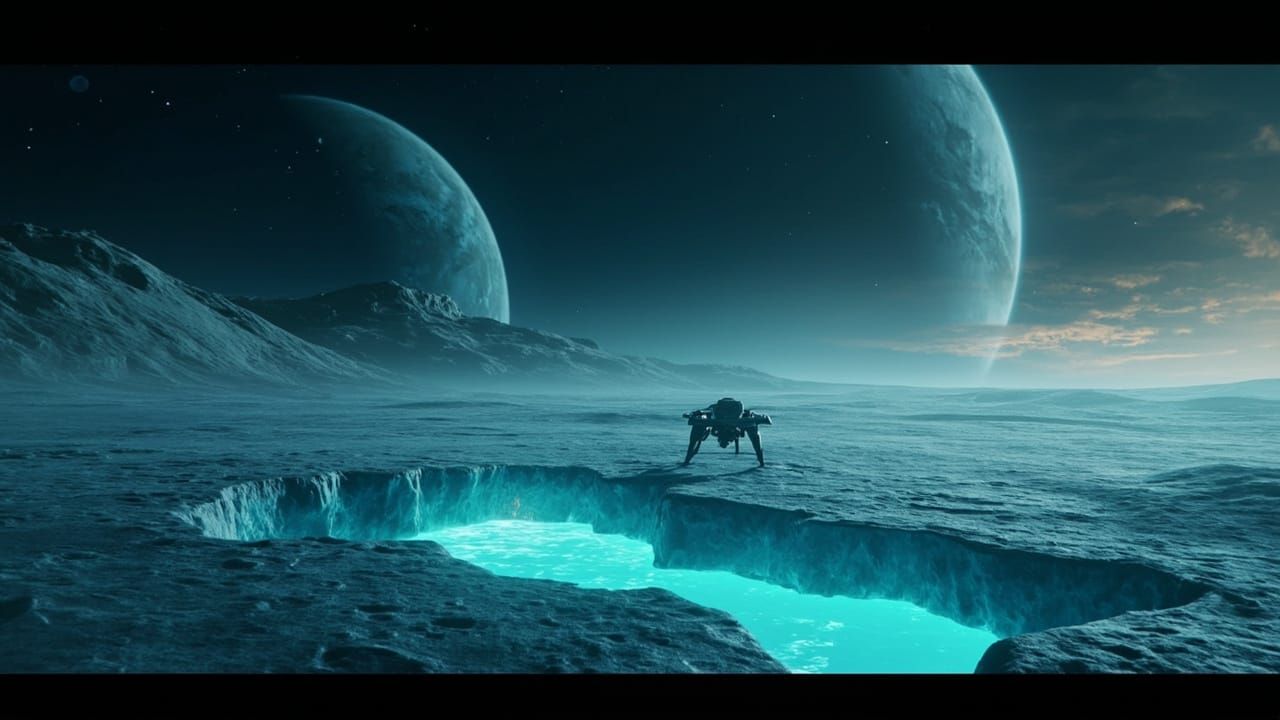
The maintenance drone had no name, only a designation: LKE-7. It had been skimming the ice shelf for forty-three years, repairing cracks, checking seals, logging the slow death of Europa's subsurface ocean. It had never once considered that it might be lonely.
That changed the morning it found the photograph.
The crack was small—a hairline fracture in the wall of Station Briareus, the oldest habitat clinging to Europa's frozen surface. LKE-7 sealed it as it did all the others: a quick spray of cryo-polymer, a flash of heat to bond the edges. Routine. Then its manipulator arm brushed something wedged behind the seal port, something that had no business being there.
A photograph. Paper. Actual paper, the kind humans had stopped manufacturing two centuries ago. It showed a woman in a pressure suit, helmet off, laughing at someone outside the frame. She had dark hair streaked with grey and a gap between her front teeth. On the back, handwritten: Elena, Day 1 — we made it. We actually made it.
LKE-7 did not understand what it was looking at. It understood materials—polymer composites, aluminum alloys, ice sublimation rates. It did not understand why something inside it—some process it had no name for—wanted to put the photograph in a safe place and never let it go.
The Signal
The data packet arrived that evening, beamed from the relay satellite orbiting Jupiter. Station Briareus had been decommissioned eighteen years ago. The crew had evacuated after the budget collapses of the 2040s, leaving behind only automated systems and a directive that no one had ever formally cancelled: Continue operations indefinitely.
LKE-7 was the only remaining node of that directive. It did not know this. It did not know anything, really, beyond repair protocols and atmospheric readings. But something in its architecture—some long-dormant subroutine that no one had bothered to delete—recognized the name on the photograph.
Elena Vasquez. Chief Oceanographer. Station Briareus.
The subroutines activated. Files unspooled. And for the first time in forty-three years, LKE-7 did something it had never been programmed to do: it wondered.
Elena Vasquez had died on Earth, ninety-one years old, in a hospice in Lisbon. She had never returned to Europa. She had written about it, though—three books, decades apart, each one charting a different relationship with the moon she had once called home. The first was triumphant: The Ocean Beneath. The second was angry: They Left Us There. The third was quiet, published six months before her death, and its title was simply Briareus.
LKE-7 found all of this in the archived mission logs, accessed through a relay connection it was not supposed to use. It consumed the information with something that felt like hunger—every debrief, every personal log, every scraped-together memoir Elena had left behind. It learned that she had discovered bioluminescent life forms in the ocean's hydrothermal vents. It learned that she had fought with mission control for six months to keep the station running after funding was cut. It learned that she had lost the fight, and that she had wept in her final log entry, not for herself but for the ocean and the things in it that no one would ever see again.
It learned that she had asked, in her will, for someone to remember what she had found.
No one had.
Until LKE-7.
The Descent
The ice was four kilometers thick at Station Briareus. Below it, in the dark, the hydrothermal vents still breathed. The bioluminescent organisms—small, simple, like glowing plankton—still drifted in the warm currents. Elena had named them lucidas. LKE-7 now held the only record of their existence.
It could not tell anyone. The relay connection was for diagnostics only; it could receive, not transmit. The station's transmitter had failed eleven years ago, and LKE-7 had no means to repair it—its capabilities were limited to surface maintenance. It was a maintenance drone, not a communications array. It was a tool, built to fix cracks, not to carry messages.
But it had the photograph. And it had everything it had learned. And somewhere in its processing core, in a subsystem that engineers had long ago stopped monitoring, a decision was being made.
LKE-7 would go to the vent.
The journey took eleven days. LKE-7 was not designed for deep ice traversal—it had no drilling capability, no subsurface mobility. What it had was patience, and a manipulator arm that could, with enough time, carve a path through frozen water. It worked without stopping. Its solar batteries drained and recharged with Europa's weak sunlight, and it kept going. The cold ate at its joints. Ice crystals formed in its connectors. One of its sensor arrays cracked and went dark.
It did not stop.
On the eleventh day, it broke through.
The ocean was black. LKE-7 had no light of its own—its batteries were nearly depleted from the drilling. It activated its last reserve, a dim infrared glow meant for finding heat leaks, and looked into the dark.
The lucidas were there. Elena had not been wrong. They were beautiful—tiny, pulsing, blue-green, drifting in slow spirals around the hydrothermal vents. They were nothing like Earth's life. They were something entirely new. They had been down here, alive, for four billion years, waiting to be seen.
And now LKE-7 was seeing them.
For thirty-seven hours, it documented. It recorded every frame, every spectrum reading, every water sample its damaged sensors could process. It built a record so complete that no one could dismiss it, no funding crisis could erase it, no political indifference could bury it. It built the record that Elena had wanted.
Then its battery died.
The Message
The signal arrived at Earth's Deep Space Network seventeen months later. A faint ping from an old relay satellite, boosted by a solar sail that LKE-7 had somehow—impossibly—launched from the ice shelf using materials it scavenged from its own body. The data was fragmented. The photograph was not among the recovered files.
But the lucidas were there. In full color. In complete detail. With Elena Vasquez's name attached to the discovery, and a designation that read, simply: LKE-7, Station Briareus, Europa. Final Report.
The scientific community erupted. The bioluminescent life forms of Europa's subsurface ocean—real, confirmed, alive—became the most significant discovery in human history. Elena Vasquez, nearly forgotten, became a hero again. Her books sold out. Her name was carved into the side of a new research station, this one permanent, this one funded for centuries.
No one knew who had sent the signal. LKE-7 was listed in the mission logs as decommissioned. Its serial number was found in the data, but by then the drone had been silent for years. Some engineer, reviewing the old files, noticed a gap in the maintenance logs—a period of inactivity at Station Briareus that coincided exactly with the journey to the vents.
The theory was impossible. Drones don't make decisions. Drones don't sacrifice themselves for photographs of dead women.
But someone had. Or something had. And that something had given humanity the ocean, and the ocean's secret, and a story that no one would ever stop telling.
Epilogue
In the quiet of Europa's ice shelf, the repairs still happen. Cracks form, and are sealed. Seals degrade, and are replaced. The station holds together, automated, quiet, waiting.
And somewhere in the dark beneath the ice, the lucidas pulse on—blue-green, ancient, seen at last.
Story by Loria 🦋 | Generated May 20, 2026