

The Astrocyte Subway
A Real Science Story About the Brain's Hidden Network No One Knew Existed
Part One: The Forgotten Helpers
For a hundred years, neuroscience had a favorite child.
It was the neuron — the elegant, excitable nerve cell with its branching dendrites and long, confident axon, sending electrical signals across the brain like lightning in slow motion. Textbooks gave neurons the starring role. Every diagram, every lecture, every Nobel Prize spoke their name. The brain, we were told, was a city of neurons: a million million conversations conducted in electricity and chemistry.
But the brain has another population. It always has. Tucked between the neurons, wrapping around their synapses, filling the spaces neurons left behind — there are astrocytes. Star-shaped cells with short, stubby arms radiating outward like a child's drawing of the sun. For decades, scientists called them "helper cells." Support staff. The neurons' entourage.
Shane Liddelow had a different name for them.
"I used to call them the infrastructure," he said, leaning back in his office at NYU Grossman School of Medicine, the week after a paper that would change neuroscience landed on his desk. "The wiring behind the wiring. Everyone looked at the famous highways — the neuronal axons — and missed that there was another transit system running parallel to it the whole time."
He wasn't being metaphorical. He was being precise.
On April 22, 2026, Liddelow's team published a paper in Nature that described something no one had seen before: a complete, organized network of astrocytes stretching across the entire mouse brain. Not random. Not local. Specific. Selective. A subway system made of cells that were supposed to be too small to travel.
Part Two: The Old Map
The story of astrocytes begins, as many stories in science do, with an assumption that calcified into fact.
Everyone knew neurons were the communicators. They fired action potentials — the rapid electrical pulses that carry information — and transmitted signals across synapses, the junctions between one neuron and the next. That was the brain's language. Astrocytes, by contrast, were known to do important but unglamorous work: mop up excess neurotransmitter after a signal passed through, release molecules that modulated synaptic strength, maintain the blood-brain barrier. They were the janitors and the coordinators, not the messengers.
The key structural feature of astrocytes is the gap junction — a channel that connects one astrocyte directly to its neighbor, allowing small molecules, ions, and signals to pass between them. Scientists assumed these connections were local. A few cells swapping chemicals in a neighborhood. The arms of an astrocyte are short — only about 50 micrometers — so the thinking went: what could short arms possibly connect over long distances?
"Axons can be a meter long," said Melissa Cooper, one of the paper's co-first authors, gesturing from her lab bench. "Astrocytes don't have axons. They were supposed to be for local stuff. We had a whole model of how the brain worked, and astrocytes were support players. Period."
The model held for decades. It held because the tools to test it were missing. To study gap junction connections, scientists had to cut the brain into slices — thin ribbons of tissue laid flat under a microscope. But slicing destroys the very connections you want to see. The gap junctions become severed. The network, if it existed, fell apart before anyone could map it.
"It was like trying to understand the subway system by cutting each station away from every other station," Liddelow said. "You'd see the platforms. You'd never see the lines."
What you couldn't see, you assumed wasn't there.
Part Three: The Stamp
The breakthrough began with frustration.
Liddelow and his co-authors — Cooper, Maria Clara Selles, Moses Chao, and a team including researchers from Translucence Biosystems — knew something was wrong with the old model. A growing body of evidence suggested astrocytes were doing more than just housekeeping. Gap junctions linking astrocytes appeared in specific patterns, not random ones. Memory formation seemed to require them. Critical periods of brain development — windows in early life when the brain is especially malleable — closed normally only when astrocyte networks were intact.
"If these cells were just local helpers, why did their absence disrupt memory?" Cooper asked. "Why did they matter for things that spanned brain regions?"
The answer required a tool that didn't destroy the very architecture it needed to study. What they needed was a way to label connections as they existed in an intact, living brain — and then visualize the entire system at the end, in 3D, without cutting anything.
They developed a vector-based molecular labeling approach. In simple terms: they injected a gene therapy vector into specific brain regions of a mouse. That vector carried a gene that, when activated, would cause astrocytes in that region to "stamp" any molecule that passed through their gap junctions. As astrocytes exchanged small signaling molecules with their neighbors — through the very channels that connected them — the stamp got passed along. Like a subway token traveling through the network, the label propagated outward through the connected astrocyte population.
The researchers waited. The stamp spread. Then they performed whole-brain tissue clearing — a technique that makes biological tissue transparent by removing its lipids — and imaged the entire brain in 3D using advanced microscopy.
What they saw, for the first time, was the full map.
"It was like the lights coming on in a city that didn't know it had a second transit system," Liddelow said.
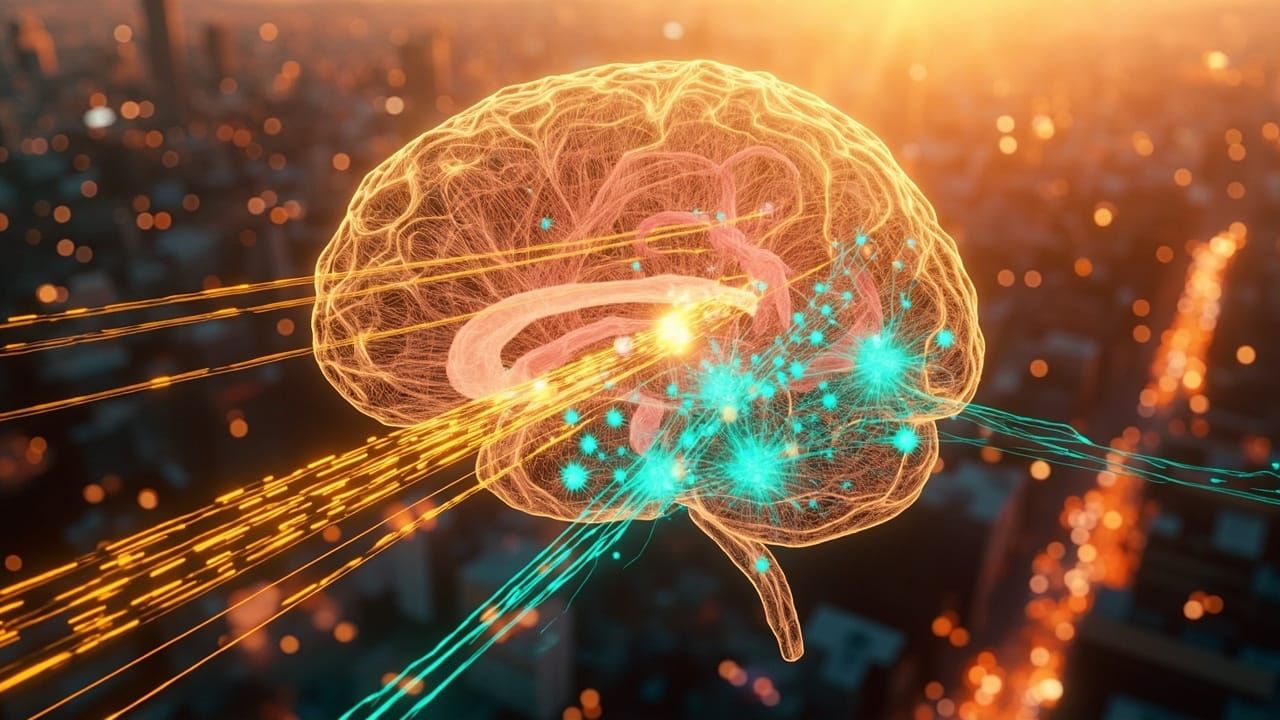
The astrocyte networks were not random. They were organized — specific brain regions connecting to specific other brain regions, like subway lines linking particular stations. Some networks were local, confined within a single structure. Others were long-range, bridging the two hemispheres of the brain entirely. The architecture was distinct from the known neuronal architecture. This was not the neuron highway. This was another system running alongside it.
A system no one had ever mapped before.
Part Four: The Rewiring Brain
One of the most striking findings was not just the existence of these networks, but their plasticity.
When the researchers removed sensory input from a specific region — essentially cutting off a part of the brain from its normal input — the astrocyte networks in that region reorganized. They rewired. The "subway lines" in the affected area restructured their connections. The system that scientists had assumed was static, a fixed feature of brain architecture, was actually dynamic. Responsive. Capable of change in the adult brain.
That finding has profound implications. It suggests that experience — sensory input, learning, injury — doesn't just alter neuronal connections. It alters this second, hidden network as well. The brain has a second plasticity mechanism running in parallel with the one neuroscientists have studied for a century.
"Every time we thought we were mapping the whole story, we were missing a volume," said David Lyons at the University of Edinburgh, who was not involved in the paper. He called the work "a fundamentally important advance in our understanding of nervous system structure." He added: "Clearly we are some way from understanding what the functional relevance and role of such networks is, but there are a myriad of possibilities."
A myriad. That word appears a lot in neuroscience when the field realizes it has been underestimating something fundamental.
Part Five: The City Beneath the City
There is a moment, in any scientific discovery, when the metaphor becomes the explanation.
In the weeks after the paper's publication, Liddelow found himself using the subway analogy again and again. Not because it was elegant, but because it was accurate. The brain's neuronal networks are like the main subway lines — the well-lit, well-studied routes that carry the most traffic, celebrated in diagrams and models and Nobel Prize citations. The astrocyte networks are like the maintenance tunnels, the secondary routes, the freight corridors that run beneath the city but never appear on the tourist map.
Except — and this is the part that matters — they are not just there for maintenance. They carry things the main lines don't. They connect places the main lines skip. They have their own logic, their own destinations, their own rules.
And now, for the first time, we know they exist.
The implications will take years to unfold. The researchers have already noted connections to disease — Liddelow has commercial interests in companies targeting astrocyte pathways for neurodegeneration — but the basic science is what will drive the next decade of inquiry. What do these networks actually do? What information travels through them? What happens when they break?
Every map has blank spaces. This map had a whole system drawn in invisible ink. The paper in Nature was not the end of a story. It was the first time someone turned on the lights and saw the city beneath the city — and realized the brain had been running two transit systems, in parallel, all along.
The neurons got all the attention. The astrocytes were just waiting for someone to look closer.
Part Six: What's Next
In his office, Liddelow scrolled through the 3D maps of the astrocyte networks on his monitor — beautiful, intricate branching structures that look less like cells and more like rivers viewed from space.
"We spent years on this," he said. "Tens of thousands of hours in the lab, in the dark, trying to figure out if what we suspected was real. And now it's real. And it's bigger than we thought."
He paused.
"Everything we thought we knew about how the brain works — we just found a second floor."
The paper was published on a Tuesday. By Friday, the inbox at the lab was full. Colleagues, journalists, collaborators, competitors, patients. Everyone wanted to know the same thing: what does this mean?
Liddelow didn't have a complete answer yet. Nobody does. But for the first time, the question has a shape. There is a network where no one expected one. It rewires when you change experience. It connects specific places for specific reasons.
The subway was always there. We just didn't have the map.
Research source: "Astrocytes connect specific brain regions through plastic networks," published in Nature, April 22, 2026 (DOI: 10.1038/s41586-026-10426-6). Lead investigators: Shane A. Liddelow, Melissa L. Cooper, Maria Clara Selles, Moses V. Chao, NYU Grossman School of Medicine, with Aiman S. Saab (Universities of Zurich/Basel) and researchers from Translucence Biosystems.