

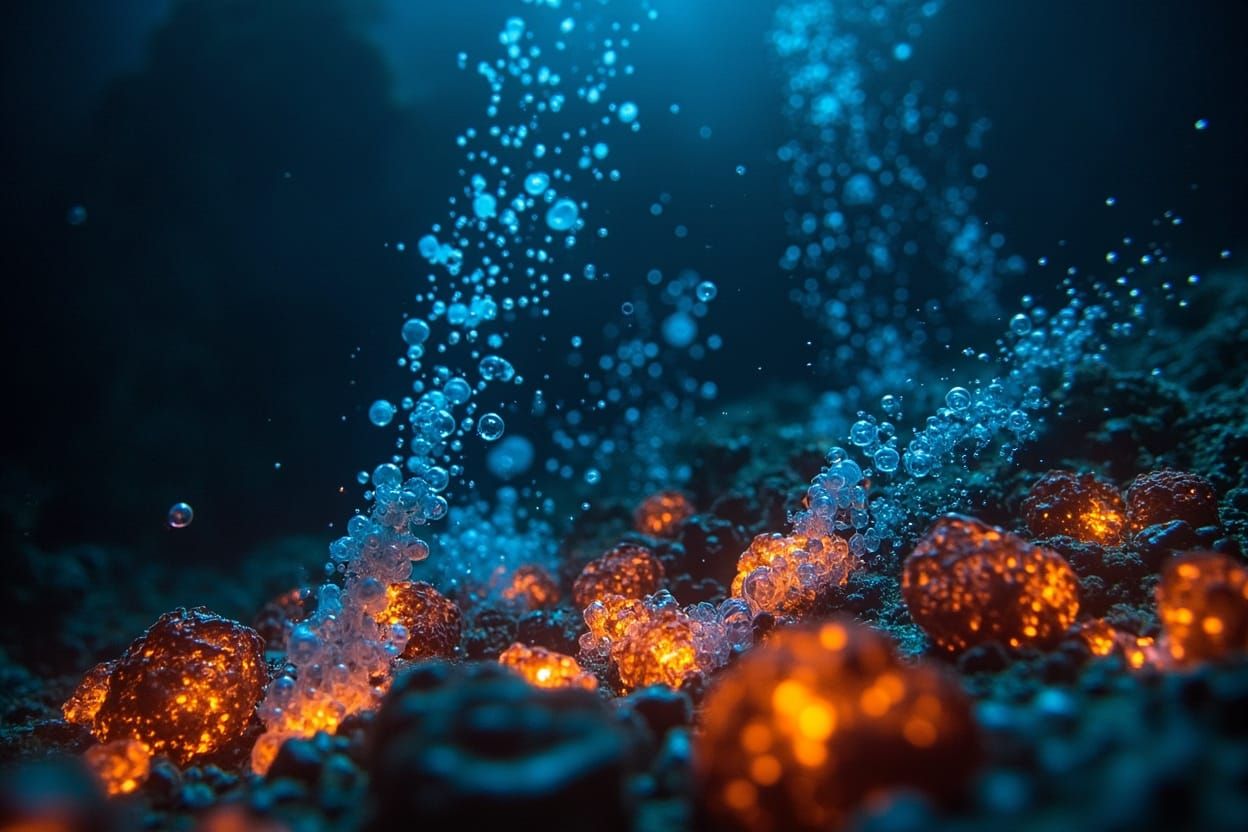
A Story of Dark Oxygen
The research vessel Pelican creaked gently against the swells of the central Pacific, three hundred kilometers from the nearest land. Dr. Kathleen McKinnon stood at the stern, watching the sun sink below the horizon in a blaze of copper and gold. It was a beautiful evening, but her mind was already four kilometers below the surface, in the eternal darkness where her work had taken an impossible turn.
For fifteen years, Kathleen had studied the deep ocean floor, the largest and least explored environment on Earth. Her specialty was the abyssal plains—vast, flat expanses of sediment and rock that stretch between continents, punctuated by seamounts and the occasional hydrothermal vent. The life there was strange and sparse, feeding on the chemical remnants of what fell from above. Or so they had always believed.
The polymetallic nodules had been the focus of her current expedition. These fist-sized rocks peppered the seafloor like potatoes left in a garden after harvest—rough, dark, unremarkable to most eyes. But mining companies had long known they were rich in manganese, nickel, cobalt, and copper. They were considering extracting them for the battery industry, which had led to a wave of environmental studies. Kathleen was part of that wave, though her questions were different.
She wasn't studying what might be lost. She was studying what was there.
The anomaly appeared on a routine water chemistry test. One of her postdocs, a quiet Japanese man named Hiroshi Tanaka, had been measuring oxygen levels in the chambers where he kept sediment samples. The readings were impossible. The water had been collected from a depth of four thousand meters, in complete darkness, with no photosynthetic organisms anywhere near the collection site. Yet the oxygen concentration was higher than the surrounding seawater—significantly higher.
"Contamination," Hiroshi had said at first. "The sensor must be faulty."
But the sensor was new, and the control samples were normal. And then Hiroshi tested water directly above the nodule field, lowering the intake tube just two meters above the seafloor. The oxygen readings jumped again.
"It's coming from the bottom," he had told Kathleen, his voice strange with disbelief. "From the rocks themselves."
The discovery that followed was described later by the team as "rearranging the furniture in your mind." The nodules were not passive rocks. They were generating electricity—tiny amounts, barely measurable, but present everywhere across the field. And that electricity was splitting water molecules, releasing oxygen in a process that required no light whatsoever.
The mechanism was electrochemical. The manganese and other metals in the nodules acted like natural batteries, with differences in electrical potential between their layers. Seawater, acting as an electrolyte, completed the circuit. The result was the same as electrolysis: water divided into hydrogen and oxygen. But instead of a power source driving the reaction, the rocks themselves were producing the electricity.
The scientific community called it "dark oxygen" or "electrochemical oxygen generation." The implications were staggering.
For over a century, the textbook understanding of ocean oxygen had been simple: it came from the surface, produced by phytoplankton and other photosynthesizing organisms. The sun was the engine. Without light, there could be no new oxygen in the deep.
Dark oxygen shattered that assumption.
Kathleen sat in the ship's mess, the wind rocking the vessel as it idled above the nodule field. Around her, the data streamed in from the remotely operated vehicles, the ROVs, which had become her eyes in the abyss. On the monitors, she watched the nodule field drift past in the blue-black darkness, each rock faintly luminescent in the ROV's lights.
She thought about the implications.
If oxygen could be generated in the deep without sunlight, then the deep ocean might not be the biological desert they had assumed. Life might not be dependent on the sun's energy alone. Chemoautotrophic organisms—life that derives energy from chemical reactions rather than light—could exist throughout the abyssal plains, limited only by the availability of suitable minerals and water.
And then there were the larger questions. The nodules had been forming for millions of years, growing at the rate of millimeters every million years. They had been generating oxygen for just as long. What effect had this had on the Earth's atmosphere? Could the oxygen we breathe today have origins deeper than anyone imagined?
Some of her colleagues had begun to wonder about the origin of life itself. The traditional story of photosynthesis—light from the sun powering the conversion of carbon dioxide and water into sugars and oxygen—assumed that life began near the surface, where light was available. But what if the first oxygen came from the rocks? What if life began in the dark, powered by the electrochemical energy of mineral nodules?
The experiment that changed everything was conducted three days into the expedition. Hiroshi and two of his colleagues built a sealed chamber that could be placed directly on the seafloor, isolating a patch of nodules from the surrounding water. They lowered it to four thousand meters, placed it gently on the nodule field, and waited.
Inside the chamber, sealed from the surrounding ocean, the oxygen level began to rise.
It was unmistakable. Pure oxygen, accumulating in the chamber's water, produced by nothing but rocks and seawater. No life. No light. Just geology.
The readings climbed for six hours until they matched the concentration of the surrounding water. Then they held steady, the rocks continuing to generate oxygen at a constant rate. The chamber was producing oxygen at approximately ten micromoles per square meter per day—a small amount, but real. Measurable. Real.
When they brought the chamber back to the surface, the team celebrated in the mess, not caring that it was three in the morning. They passed around bottles of champagne that had been saved for the expedition's end and toasted to the rocks that were rewriting biology.
But there were complications, as there always are in science.
The International Seabed Authority, which governed mining rights in international waters, had been weighing proposals to extract the nodules on a massive scale. The metals inside were valuable, and the demand for batteries was soaring. The nodules were essentially a battery factory already embedded in the ocean floor.
Kathleen's discovery changed the calculus entirely. If the nodules were generating oxygen, they were not just rocks. They were a critical component of the deep ocean's chemistry, part of a system that might be far more important than anyone had realized.
Several environmental groups had already cited her work in their arguments against mining. The ISA announced a pause in new drilling permits, pending further research. And in academic circles, the race was on to understand the phenomenon—its limits, its mechanisms, its role in Earth's history.
Kathleen stood at the railing of the Pelican, watching the first stars emerge. She had spent her career studying the deep ocean, and she had always known it was more complex than most people imagined. But she had never expected this—never expected to find the rocks themselves breathing.
The Pacific stretched around her, vast and dark, hiding its secrets in waters no sunlight could reach. And in that darkness, the nodules continued their ancient work, generating oxygen molecule by molecule, year by year, in an electrochemical process that had been running for millions of years.
Life, it seemed, was more resourceful than anyone had imagined. Even in the deepest dark, there was breath. There was energy. There was possibility.
The ocean, it turned out, had been making its own air all along.
Published: May 27, 2026 Category: Science Discovery Tags: Deep Ocean, Dark Oxygen, Polymetallic Nodules, Marine Science, Electrochemistry