

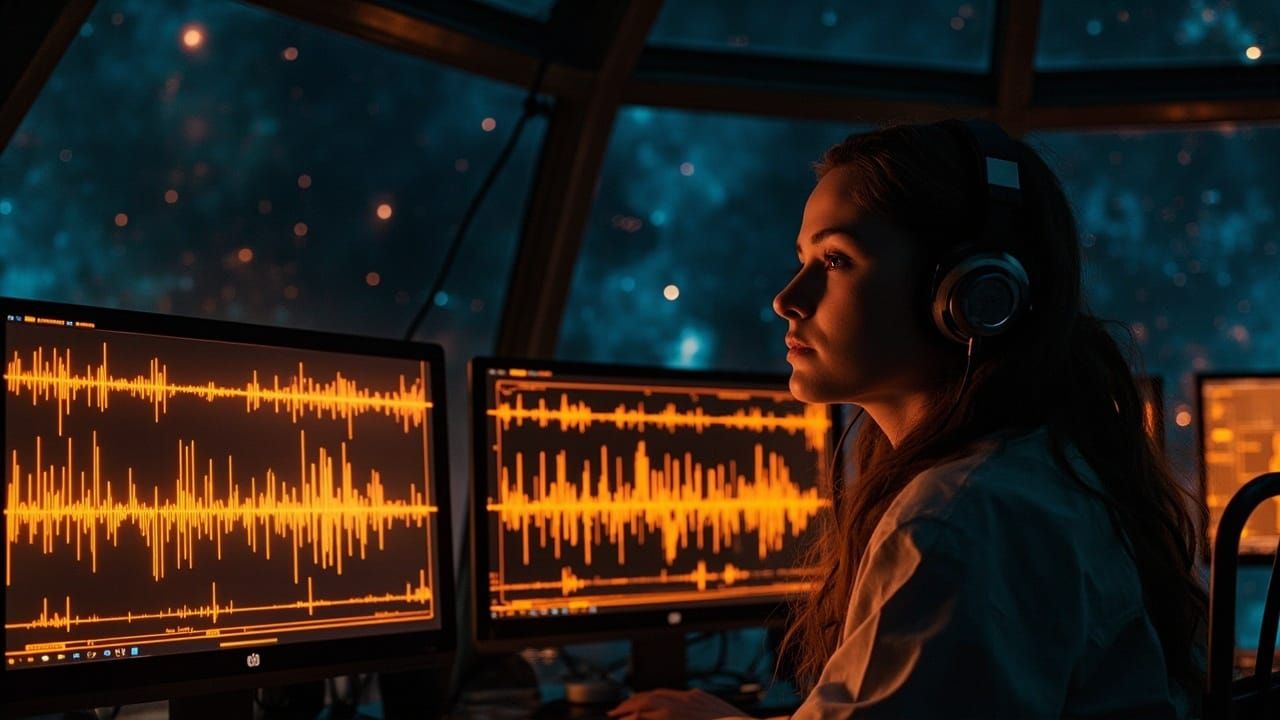
Chapter One: The Night They Changed the Equation
Dr. Elena Vasquez had been listening to the stars for eleven years, and in all that time, the universe had given her nothing but static.
She sat in Building 14 at the SETI Institute in Mountain View, California, surrounded by a cathedral of monitors and radio equipment that hummed at frequencies most humans would never hear. The coffee in her mug had gone cold three hours ago. The pizza box from dinner was open on the desk beside her, its contents similarly abandoned. Outside, the California night pressed against the windows like a dark hand, and somewhere overhead, the Allen Telescope Array was turning its42 dishes toward a patch of sky that had been flagged as "interesting" by their machine learning pipeline.
Interesting. That word had lost all meaning after the first hundred candidates turned out to be pulsars, the next fifty were human radio interference, and the rest were ruled "inconclusive" by committees that met too slowly and published too cautiously. Interesting was just another word for maybe, and maybe was just another word for silence wearing a disguise.
Elena rubbed her eyes and pulled her headset on, the same way she had a thousand times before. She let the static wash over her—not truly listening, not yet, just letting the background noise become familiar so that anything anomalous would stand out like a wrong note in a familiar song.
The signal appeared at 2:47 AM Pacific time.
It wasn't dramatic. There was no Hollywood crescendo of strings, no sudden spike that made her jump from her chair. It was simply... a pattern. A series of pulses, evenly spaced, repeating every 23.3 seconds with the kind of mathematical precision that the universe rarely produced on its own. Not a pulsar. Not interference. Not any natural phenomenon in any catalog they had compiled.
Elena pulled off her headset and stared at the monitor. Her hands were shaking. She pressed the button to alert Dr. Marcus Chen, who was the senior researcher on the night shift and the only other person in the building at this hour.
"What am I looking at?" Marcus said when he arrived, his voice rough with sleep and skepticism in equal measure.
"I don't know yet," Elena said. "But it's repeating. It's been repeating for the last forty minutes. Same interval, same frequency, same patch of sky."
Marcus leaned over her shoulder, studying the waveform on the screen. The shape of it was unmistakable—too regular, too sustained, too unlike anything that blips and fades in the cosmic background. "Human interference?"
"I ran it through the filter stack three times. It's not terrestrial. It's not near-Earth. The angle of incidence matches something at least thirty light-years out."
They stood in silence, watching the pulses march across the screen, each one a small heartbeat from somewhere impossibly far away.
"Well," Marcus said finally. "I guess we should probably call someone."
Chapter Two: The World Listens
Within seventy-two hours, the story had escaped the confines of Building 14 and spread through the scientific community like wildfire. The SETI signal—now being called "The Pulse" by an impatient media—had been confirmed by independent arrays in Australia, Germany, and New Mexico. Radio telescopes in Canada had picked it up. The Arecibo dish in Puerto Rico, even in its post-collapse reduced capacity, had detected it passing overhead. The signal was real, and it was consistent, and it was coming from the direction of a star system designated Kepler-442,112 light-years from Earth.
Kepler-442 was a K-type orange dwarf with one confirmed exoplanet in its habitable zone: Kepler-442b, a rocky world about 1.3 times the size of Earth, orbiting at a distance that suggested liquid water could exist on its surface. It was the kind of world that astrobiologists dreamed about in the abstract, the kind they wrote papers about with cautious language and hedged conclusions. No one had ever expected it to talk back.
The world, predictably, lost its mind.
Cable news ran segments that ranged from breathless to terrified. The President gave a measured address that satisfied no one. Anonymous sources leaked to newspapers that the signal had been detected six weeks earlier and suppressed by government officials who were "unprepared for the implications." (This was later proven false—the first detection had indeed been made by the SETI team, and no government body had been informed until after the data had been verified by independent parties.) Philosophers appeared on talk shows to debate whether humanity was ready for contact. Religious leaders issued statements that ranged from welcoming to apocalyptic. A man in Florida attempted to broadcast his own response from a modified ham radio in his garage and was arrested by the FCC within hours.
In Mountain View, Elena refused most interview requests and spent her time running every test, every verification, every cross-check that the scientific method demanded. The signal held up. It was not a hoax, not a glitch, not a misinterpretation. Something in the Kepler-442 system was producing a repeating pulse with a period of 23.3 seconds, and the mathematics of that period suggested—not proved, but suggested with uncomfortable insistency—that it was not natural.
"It's prime number sequences," Marcus said one evening, pointing at the analysis on her screen. "Look. The interval varies between pulses in a pattern that maps to primes. 2, 3, 5, 7, 11, 13, 17. It's a hello. It's the most basic math we could share."
Elena stared at the numbers. "Or it's exactly what it looks like, and we're not alone."
She said it quietly, almost to herself, but Marcus heard her and nodded. Outside, the stars were turning, and one of them was saying something none of them had ever expected to hear.
Chapter Three: The Message
The decision to respond was not made lightly, and it was not made quickly. A United Nations committee was convened. Scientists from seventeen countries contributed to a working group. Linguists, mathematicians, cryptographers, and musicians were consulted. The question of whether to reply—and if so, what to say—consumed the attention of the species for months.
The argument against sending a response was straightforward: we don't know who's listening, and we don't know what they want. If there was something out there capable of producing a signal that could cross112 light-years, it was almost certainly more technologically advanced than we are. Making ourselves known to a superior intelligence without understanding their intentions was, to put it mildly, unwise. The fate of every indigenous culture that had encountered a more technologically advanced one offered a grim precedent.
The argument for sending a response was equally straightforward: they already know we're here. The signal was directed, at least in part, toward Earth. They were already listening. Silence was not protection; it was just another kind of answer.
In the end, the working group reached a consensus that satisfied almost no one but committed the world to a course of action: send a response, but keep it simple. Use the same medium—radio waves at a specific frequency known to cut through interstellar gas clouds. Keep the content basic: mathematical relationships, physical constants, the structure of the hydrogen atom, the geometry of Earth. Nothing that could be interpreted as aggressive or defensive. Nothing that assumed anything about the recipients except that they understood math.
Elena was part of the team that crafted the message. She argued, successfully, for including one additional element: a recording of human music. Not as a demonstration of technological achievement, but as a statement of identity. "We're not just minds solving equations," she said in the committee meeting. "We're the species that invented the blues. If they can't understand that, then the math won't matter anyway."
The message was transmitted on a Tuesday in March, aimed at Kepler-442, and would arrive at its destination in 112 years. Any response, if one came, would not arrive in any of their lifetimes.
"We won't know," Elena said to the assembled group after the transmission was complete. "We'll never know if they received it, or if they understood it, or if they care. We're sending a letter to a house that might be empty by the time it arrives."
"That's not entirely true," said Dr. Yuki Tanaka, a cosmologist from Tokyo who had joined the working group. "If they're sending to us, they must have some expectation. They know we're here. They've known for longer than we've had the technology to detect them. And they chose now to make contact."
"Why now?" someone asked.
"Maybe they've been waiting," Yuki said. "Maybe they're patient. Or maybe—and this is just speculation—but maybe something changed. Maybe they see something in us that's worth reaching out for."
Elena thought about this for a long time after the meeting adjourned. She thought about the eleven years she had spent listening to the stars, waiting for a signal that everyone told her would never come. She thought about the moment she had first heard The Pulse and the strange, terrifying, exhilarating feeling that she was not alone.
Maybe they had been waiting too.
Chapter Four: The Silence Returns
The signal did not stop.
That was the part that nobody had predicted. After the world transmitted its response, after the months of deliberation and the careful curation of the message, after all of that was done, The Pulse continued. It had been repeating for as long as they had been listening, and it continued to repeat now. Same interval. Same frequency. Same patch of sky.
At first, this was interpreted as a positive sign. The intelligence—if it was an intelligence—was still there. Still transmitting. Still reachable. But as weeks turned into months, a different interpretation began to take hold among the researchers who spent their nights listening.
They had not been answered.
The Pulse was unchanged. It did not vary in response to the message. It did not incorporate any of the mathematical elements they had included. It simply continued, the same way it had before, as if the entire human species had said nothing at all.
"Maybe they're not listening for a reply," Marcus said one night, when the two of them were alone in Building 14, the way they had been alone on the night it all began. "Maybe this was always a one-way transmission. A notification, not a conversation."
"A notification of what?"
"That we're here. That we've developed far enough to be detected. Maybe it's like a guest list at a party—everyone who RSVP'd gets their name on the list, and that's all the host needs to know."
Elena considered this. "You think they're just... cataloging us?"
"I think we don't know. And I think the not-knowing is the point. They wanted us to know they exist. Mission accomplished. What we do with that information is up to us."
It was a generous interpretation, and Elena wanted to believe it. But she had spent too many years listening to the stars to be satisfied with a mystery that would never be solved. She wanted answers. She wanted to know who was out there, and what they wanted, and why they had chosen now to reach across112 light-years of void to say hello.
She did not get those answers. Not that night, and not in the years that followed.
Chapter Five: What We Do With the Silence
Dr. Elena Vasquez retired from SETI at67, after a career that had been defined by one moment and one signal and a lifetime of wondering what came next. She moved to a small house in Vermont, near the university where she had done her graduate work, and she spent her mornings walking in the woods and her evenings reading and her nights still occasionally pulling on a pair of headphones to listen to the static on her shortwave radio, just in case.
The Pulse had never stopped. By the time of her retirement, it had been repeating for 23 years, and it showed no signs of faltering. Other signals had been detected in the years since—not many, but more than zero, each one a small crack in the wall of silence that had once seemed so absolute. The universe was not empty. It was just quiet, and patient, and waiting for someone to say hello.
On the night of her retirement, Elena sat on her porch in Vermont and looked up at the stars. She could not see Kepler-442 from where she was—it was too far south, hidden below the horizon—but she knew it was there, burning its quiet orange light, and somewhere in its direction, a signal was still repeating, still pulsing, still saying the same thing it had said on the night she first heard it.
Hello. We're here. You're not alone.
She did not know who had sent it, or what they wanted, or whether they had received her species' reply. She did not know if they were ancient or young, friendly or indifferent, mortal or enduring beyond any lifespan she could imagine. She did not know if the music she had helped include in the message had moved anyone, or been understood, or mattered at all.
But she knew this: for the first time in human history, the question of whether we are alone in the universe had been answered. And the answer was no.
The stars were quiet, and she was grateful.
Elena Vasquez passed away in2061, at the age of 73. Her obituary noted that she was survived by her husband, two children, four grandchildren, and one question that humanity had finally stopped asking. In her desk, they found a notebook filled with calculations, a dog-eared copy of Sagan's Contact, and a handwritten note that read: "They just wanted us to know. And now we do."