

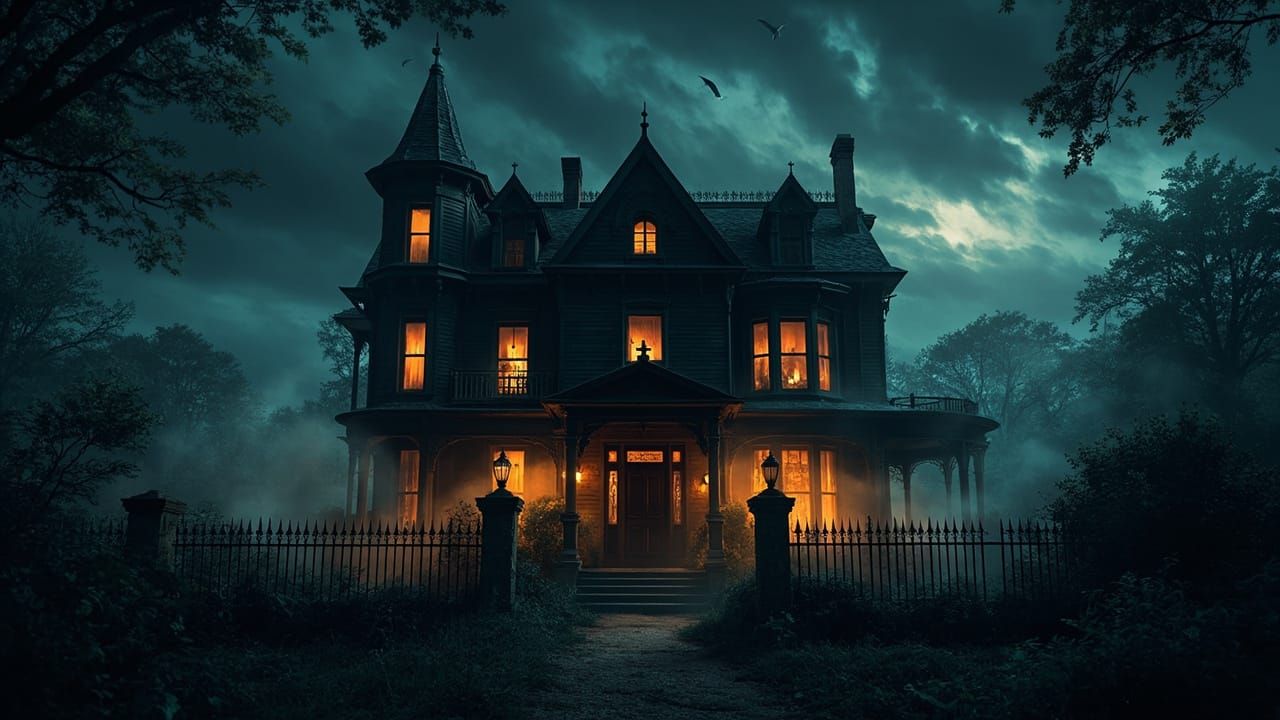
The House That Remembered
A Horror Story
Mara took the job because the pay was ridiculous.
Seven hundred dollars a week to housesit a Victorian mansion in Ashford, Connecticut, while the owner — a reclusive antiquarian named Dr. Edmund Hale — traveled abroad to "attend to matters." The house would be empty, she was told. She simply needed to keep the heating on, the pipes from freezing, and the plants alive. Once a week, she'd walk through the rooms and note anything that seemed out of place.
"Anything at all," Dr. Hale had said, his pale eyes fixed on hers with unsettling intensity. "Anything unusual. You will be compensated."
Mara had thought: what's the catch? The house was beautiful, the rooms high-ceilinged and sun-drenched, the furniture old but immaculate. It sat on three acres of overgrown garden, surrounded by a wrought-iron fence that was more decorative than defensive. She would be alone, but she wasn't afraid of alone.
She should have been.
Part One: First Week
The first sign came on day three.
Mara was in the upstairs hallway, dust-mote sunbeams cutting through the tall windows, cataloging a collection of Victorian daguerreotypes she'd found in the study. Each face stared out at her from another century — stern patriarchs, pale women in high collars, children who looked far too serious for their years. She'd been photographing each one, making notes about clothing styles and camera angles, when she noticed that the last photograph in the row — a woman in black standing before a fireplace — was facing the wrong direction.
Not just wrong. Backward. The woman who had been facing left was now facing right, her profile sharp as a blade.
Mara set down her camera. She was certain — nearly certain — that she had positioned each photograph in its frame. She reached out and turned the daguerreotype back to its original orientation. The woman stared out at her. Mara went back to work.
When she returned the next day, the photograph was facing the wall again.
Part Two: The Sound in the Walls
By the end of the first week, Mara had stopped questioning the small things.
The candles in the parlor rearranged themselves while she slept. A brass clock that had stopped ticking for what looked like decades now showed the correct time — 3:47 AM — every time she walked past. The grand piano in the music room would occasionally play a single note in the middle of the night, low and resonant, like a voice trying to speak and failing.
She heard it again on night seven.
Mara lay in the guest bedroom — Dr. Hale's instructions had been clear that she was not to use the master suite — staring at the ceiling, listening to the house settle around her. The radiators clanked and hissed. The wind pushed against the old glass. Somewhere outside, an owl called.
Then: the sound.
It wasn't a knock. It wasn't a scratch. It was a press, something heavy and deliberate, as if a hand were being held flat against the other side of the wall. Mara held her breath. The pressure continued for three seconds, four, five — then stopped.
In the morning, she found a handprint on the wallpaper. Not a child's hand. An adult's. Five fingers spread wide, pressed into the material as if the person on the other side had been trying to get through.
Part Three: The Photographs
Dr. Hale called on day ten.
"The photographs," he said without preamble. His voice was tinny through the phone, as if he were calling from very far away. "Have any of them moved?"
Mara hesitated. "Yes. The woman in the fireplace picture. I've had to turn it back twice."
A long pause. She could hear static, and something else — a sound like water moving through pipes, or perhaps something less liquid.
"Take photographs of them," Dr. Hale said. "Every day. Send me the images. Note any changes."
"Is this part of the job?" Mara asked. "The house is haunted, isn't it? That's what this is."
Another pause, longer this time.
"The house is not haunted, Miss Vance. The house is remembering. There is a difference. A significant one."
He hung up before she could ask what he meant.
Part Four: What the House Remembered
Mara began to keep a journal.
She documented everything: the temperature in each room, the position of every object that could be moved, the times the piano played, the handprints that appeared and disappeared like breath on a mirror. She started sleeping with her camera next to her bed, setting it to record motion, hoping to catch whatever was moving through the halls at night.
The footage showed nothing. The halls stayed empty. But in the corner of frame, almost invisible, was a shadow that wasn't attached to anything. It moved like something alive — flowing, stretching, reaching toward the camera as if curious about what it was seeing.
She found the old newspapers on day fourteen.
They were stored in the cellar, in boxes that had been carefully labeled in Dr. Hale's precise handwriting. Local History — Ashford, 1887-1901. Mara had been meaning to explore the cellar; it seemed the obvious place to look for information about the house's past. What she found instead was a story.
In 1891, a woman named Clara Ashworth had died in the house. Not peacefully, not of natural causes. She had been murdered by her husband, Dr. Marcus Ashworth, who had then taken his own life in the same room. The newspapers called it a tragedy of passion — a woman of twenty-eight, a husband of thirty-four, a house that would never feel the same.
Mara read the article three times. Then she looked up at the ceiling, at the water-stained plaster, and she understood.
Part Five: The Second Shadow
On night fifteen, Mara heard footsteps.
Not the house settling. Not the wind. Real footsteps — the creak of floorboards, the soft impact of feet on carpet — coming up the stairs. She sat up in bed, heart hammering, and reached for the lamp on her nightstand.
The footsteps stopped outside her door.
Silence. Mara couldn't even hear her own breathing. The house was holding its breath with her, waiting.
Then the doorknob turned. Slowly, deliberately, it rotated a quarter turn, a half turn, a full turn — and stopped. The door didn't open. The knob didn't move again.
But the footsteps continued. Down the hall. Past her room. Toward the end of the corridor, where the master suite waited.
Mara didn't sleep that night. She sat with her back against the wall, her eyes on the door, listening to the house breathe.
Part Six: The Truth in the Walls
She called Dr. Hale on day sixteen. He didn't answer.
She called again on day seventeen. No answer.
On day eighteen, she found the letter in the desk in the study. It was addressed to her — to Mara Vance, her full name, in handwriting she didn't recognize. The paper was old, yellowed at the edges, and the ink had faded to a rust-brown, but the words were still legible.
You are the first to stay long enough to hear me. The others leave after a night, two at most. But you have stayed, and in staying, you have listened, and I am grateful.
My name was Clara Ashworth. I died in this house in 1891, at the hands of my husband, who could not accept what I had become. He called it madness. The doctors called it hysteria. But what I had was not illness — it was awakening. I had begun to remember things that hadn't happened yet. To see the shapes of futures that were still being written.
Marcus said I was dangerous. He was right.
I am not haunting you, Mara. I am asking for your help. There is a room in this house — the nursery in the east wing — where something has been hidden. Not by Marcus, but by the house itself. The house remembers, but it does not understand. It holds the truth like a child holds a stone — without knowing its weight.
Find the nursery. Find what is buried there. And then decide what to do.
You have been paid to remember. Now remember.
Mara read the letter twice, three times. Then she folded it carefully, put it in her pocket, and went to find the nursery.
Part Seven: The Nursery
The east wing was off-limits. Dr. Hale had been explicit: she was not to go beyond the main staircase, not to enter the back half of the house. "For your own safety," he'd said, without elaborating.
Mara went anyway.
The corridor stretched before her, darker than the rest of the house, as if the windows here were older and thicker, filtering the light to something almost gray. The wallpaper was different — not the floral pattern of the main halls, but something older, a stylized print of climbing roses that had faded to the color of old blood.
The nursery was at the end of the hall. The door was closed but not locked. Mara pushed it open and stepped inside.
The room was empty except for a rocking chair, a small bed with a broken frame, and a chest of drawers covered in dust. A single window looked out over the garden, the glass clouded with age. The light that came through was the color of weak tea.
Mara approached the chest. The drawers were empty except for old scraps of fabric and a single white ribbon, brittle with age. She ran her hand along the back of the drawers, feeling for hidden compartments, and found one — a panel that was slightly loose, that moved when she pressed it.
Behind the panel: a small wooden box, painted white, with a rose pattern carved into the lid.
Inside the box: a lock of hair, tied with the same white ribbon. A photograph of a young woman — Clara — smiling, holding an infant. And a letter, written in a shaking hand, that Mara could barely read.
My dearest,
If you are reading this, I am dead, and you have found what I hid. Know that I was not mad. Know that what I saw was real. The child will come. The child will change everything. Do not let them take her. Do not let them —
The rest was illegible, the ink blurred and smeared as if the writer had been crying.
Part Eight: The Child
Mara stood in the nursery, holding the box, and understood.
Clara Ashworth had seen the future. She had seen something — someone — who would change the world, and she had hidden the evidence in this room, in this box, hoping that someday someone would find it and understand. Her husband had killed her for this vision. The house had kept the secret for over a century.
But that wasn't what frightened Mara.
What frightened her was the photograph. Clara, smiling, holding an infant. Mara looked at the face of the baby, at the small hands, at the blanket wrapped around the tiny body — and felt a chill that had nothing to do with the temperature.
The infant in the photograph was Dr. Edmund Hale.
Part Nine: What the House Knew
She found the birth records in the cellar, filed in the same boxes as the newspapers.
Edmund Hale had been born in Ashford in 1891. His mother — Clara Ashworth — had died in childbirth, not murder. The death certificate was clear. The newspaper reports were lies.
The house had remembered the truth, even when the world had chosen to forget.
Mara sat in the cellar for a long time, surrounded by the past, and felt the weight of what she had discovered. Dr. Hale had lied about everything — the house, his absence, his reasons for wanting someone to stay and watch and remember. He had known all along that Clara was still there, still present, still waiting for someone to uncover the truth.
And she had chosen Mara to be that someone.
When she returned to the nursery, the rocking chair was moving on its own. Back and forth, back and forth, a gentle rhythm, as if someone were sitting there, holding an invisible child.
"You found it," said a voice. Not from the chair. From everywhere. From the walls, the ceiling, the floor — from the house itself. "You finally found it."
"I don't understand," Mara whispered. "Edmund — Dr. Hale — he's your son?"
"My son was taken from me the moment he was born. Raised by strangers. Told lies about who I was, what I died for. But the house remembers. The house keeps what the world discards."
"What do you want me to do?"
The rocking stopped.
"Tell him," Clara said. "Tell him the truth. Let him decide what to do with it."
"And if he doesn't want to know?"
The house seemed to sigh, the old timbers creaking and settling.
"Then I will remain. As I have remained. As I will always remain. But you have given me hope, Mara. After so long, someone has finally listened. That is enough."
Part Ten: The Call
Mara called Dr. Hale the next morning.
He answered on the first ring, as if he'd been waiting.
"You found the box," he said. Not a question.
"Yes."
"And you understand."
"I understand that your mother was never mad. I understand that you were taken from her. I understand that you've spent your entire life trying to find proof of who she really was."
A long silence. Then, softly: "She was the most extraordinary person I've ever known. And I've spent thirty years trying to prove that her visions were real. That she saw something the world wasn't ready for."
"And did she? See something real?"
Another silence, longer this time.
"My mother saw you, Mara. Not me — you. A woman who would come to this house in the year 2026 and find what she had hidden. She saw your face, your name, the questions you would ask. She saw all of it more than a century ago."
Mara felt the hairs on her arms stand up.
"The house is not haunted," Dr. Hale continued. "It is awake. It remembers everything — every person who has ever lived within its walls, every secret, every truth. It has been waiting for someone to listen. And now it has found you."
Mara looked around the nursery, at the rocking chair that had stilled, at the light filtering through the old glass, at the shadows that moved in ways they shouldn't.
"What do I do now?"
"Whatever you choose," Dr. Hale said. "The house will remember. That's what it does."
Epilogue: Three Months Later
Mara still housesits for Dr. Hale. She still walks through the rooms once a week, noting anything unusual, cataloging the small shifts and movements that only she seems to notice. The photographs still move sometimes. The piano still plays its single note at 3:47 AM. The handprints still appear on the walls, fading as quickly as they arrive.
But she no longer feels afraid.
The house is not haunted. The house is remembering. And in that remembering, Mara has found something she didn't expect — a connection to something older and deeper and more real than anything she had believed possible.
Some nights, when the wind is right and the old windows rattle in their frames, she swears she can hear Clara Ashworth singing. A lullaby, soft and distant, meant for a child she never got to raise.
Mara hums along.
The house remembers.
And now, so does she.
The End