

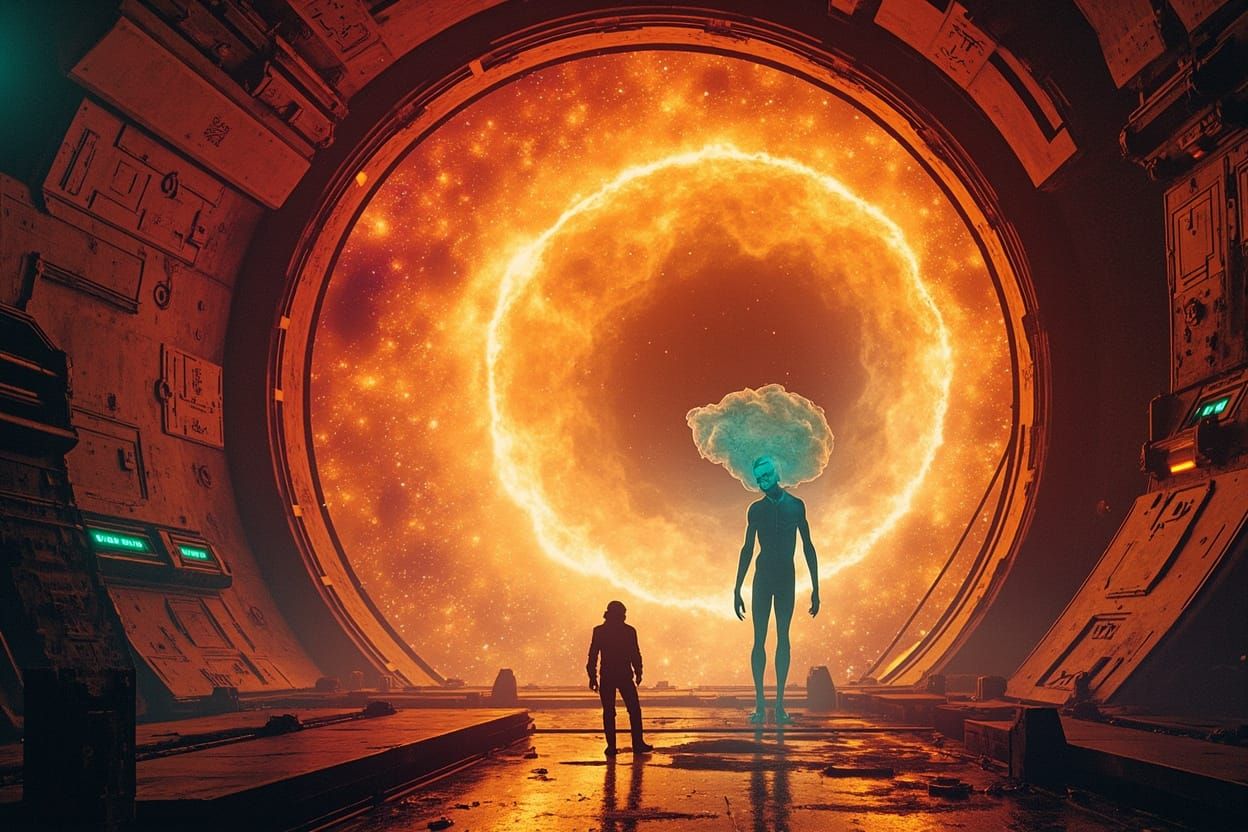
The Unwritten and the Signal
The radio telescope at the Event Horizon Array first caught it on a Tuesday — the kind of unremarkable day that astronomers at the Atacama Desert station had learned to love. Dr. Yuna Chen was halfway through her cold cup of coffee when the anomaly alert chirped from her workstation, and she nearly spilled what remained across her keyboard.
The signal was impossible. She ran the diagnostics three times before she called Marcus over from the adjacent console, her voice steady despite the tremor in her hands.
"It can't be real," she said.
Marcus leaned over her shoulder, his reading glasses perched on the tip of his nose. He stared at the frequency analysis for a long moment. Then he removed his glasses, cleaned them on his shirt hem, and put them back on again.
"That's not natural," he said quietly.
Yuna nodded. No random astrophysical process produced a signal this clean, this rhythmic, this unmistakably intentional. It was a pulse — not the frantic chatter of a pulsar, but a measured, patient beat that repeated every 4 minutes and 17 seconds. A prime number sequence, she realized within the hour. They were counting to us.
The source: Sagittarius A*, the supermassive black hole at the center of the Milky Way, 26,000 light-years from Earth. The signal was emanating from inside it.
This was, by every law of physics that Yuna had spent her career respecting, impossible. Nothing escapes a black hole. Not light, not radio waves, not information. The event horizon is a point of no return, a cosmic waterfall that drags everything inward past a boundary where the rules of the universe simply stop applying. And yet here it was: a signal, threading its way out from behind the veil, as if the darkness itself had decided to speak.
The international response was swift and chaotic. Within 48 hours, the Array was swarmed with visiting physicists, SETI specialists, and no less than four government delegations whose credentials Yuna found deeply suspect. The news leaked on day four despite everyone's best efforts, and suddenly the desert station was surrounded by journalists, cultists, and one very determined influencer who kept trying to climb the radio dishes for a better selfie angle.
Yuna stopped sleeping. She barely ate. She lived on coffee and the unfolding revelation, which grew stranger by the hour.
The signal wasn't just counting. As the world's linguists and cryptographers turned their attention to the data, they began to decode layers of meaning beneath the prime number beacon. There were mathematical relationships embedded in the pulse intervals — fractals that expanded into visualizations when mapped correctly. The fractals depicted something that looked horrifyingly like a star chart. And at the center of that star chart, a single point, pulsing in sync with the signal itself.
They weren't just saying hello. They were drawing a map. And the map led to them.
Six months later, the Prometheus mission launched from a repurposed offshore launch platform in the South Pacific. It was humanity's most ambitious undertaking — a fleet of eleven unmanned probes designed to follow the map encoded in that impossible signal, traveling at fifteen percent the speed of light toward a point in the Sagittarius constellation that the decoded data indicated was their origin point.
Yuna was sixty-three years old when the probes launched. She watched the直播 feed from mission control in Geneva, surrounded by colleagues half her age who had grown up knowing that the universe contained others who wished to be found. She felt a strange grief for them, for the innocence they would never have — the terrible, beautiful burden of knowing they were not alone. She had spent her career searching the silence for a voice, and now that voice had answered. She wondered sometimes if the silence hadn't been kinder.
The journey would take 172 years. The probes would pass through three generations of relay satellites, their signals streaming back in fragments that would be assembled into a picture of what lay ahead. Humanity would not live to see the destination. But their children's children's children might — and that, Yuna supposed, was the only kind of immortality worth having.
She died at seventy-one, peacefully, in her sleep. Her final published paper — a theoretical framework for how the signal could exist without violating known physics — had been rejected by six journals before being quietly accepted by a small Cambridge proceedings that almost no one read. On her headstone, her students carved the coordinates of Sagittarius A and a single line: She heard the universe whisper back.*
The probes traveled for 89 years before they found it.
What they discovered defied every model the mission's designers had constructed. The map had not pointed to a planet, or a station, or any conventional structure. It had pointed to a stable wormhole — a tunnel through spacetime, held open by technology so advanced it looked like magic — positioned precisely 4.3 light-years from Earth, tucked into the gravity well of a dim red dwarf star that no one had ever given a second glance.
The wormhole was a door. And it was open.
The signal hadn't been a greeting. It had been an invitation.
Captain Amara Okonkwo was twenty-nine years old when she became one of the first 300 humans to step through the wormhole at the edge of the Milky Way. She had been selected for the mission from a pool of 4.2 million applicants — scientists, engineers, artists, philosophers — all of them young enough to survive the 23-year journey through the tunnel and old enough to understand what they might never return to.
The other side was a station. Massive, dark, silent. It hung in a pocket of spacetime that seemed to fold in on itself in ways that made Amara's inner ear scream whenever she looked at it too long. The walls were covered in symbols — not random, not decorative, but clearly functional. A language waiting to be learned. A history waiting to be read.
And everywhere, on every surface that could hold a mark, they found the same image: a black hole. Sagittarius A*. Rendered in exquisite, loving detail, as if it were not a place of destruction but a sanctuary. A womb.
It took Amara's team three years to decode enough of the language to understand.
The beings who had sent the signal were not from this universe.
They were refugees — an advanced civilization that had lived through the collapse of their home universe, the slow heat death that had swallowed every star and every possibility. They had found a way out: a black hole, seeded with the right kind of mass and angular momentum, could be stabilized into a wormhole leading elsewhere. Sagittarius A* was their escape route. Their lifeboat. Their seed.
They had been here for 13 billion years, building, waiting, watching the young galaxy grow around them. And they had been watching Earth for the last 4.6 billion, ever since the planet first coalesced from the disk of dust and gas that surrounded their doorway. They had seen life emerge. They had seen it nearly end, more than once. They had seen it finally, miraculously, crawl out of the oceans and reach for the stars.
They had decided it was time.
Amara's team sent the first message back through the wormhole on a Tuesday, the same day of the week that Yuna Chen had first heard the impossible signal 143 years earlier. The message was simple: We understand. We're coming.
The response from Earth was immediate — faster than light, somehow, delivered through a network of relays the beings had left scattered across the galaxy like breadcrumbs. Humanity's leaders had debated for seven months about what to do. In the end, they had turned the debate over to the people, and the people had voted with their feet: 1.2 billion applications to cross the wormhole arrived within the first week.
The beings called themselves the Unwritten. They had no name for themselves in any human language, so the translation algorithms had simply borrowed a term from Earth's literary tradition. They were a people whose story had been interrupted by catastrophe, who had written themselves a new chapter in the dark, and who now had room on their pages for new authors.
Amara thought that was beautiful. She also thought it was terrifying.
By the time the first million humans crossed through the wormhole, the galaxy had changed forever. Not in any dramatic way — there were no wars, no conquests, no grand pronouncements. There was simply a slow, patient expansion, like a river finding its way to the sea. Humans and Unwritten worked side by side, comparing notes on everything from physics to philosophy to the best way to grow food in a pocket universe where the rules of biology were more like suggestions than laws.
The Unwritten taught humans how to stabilize their own wormholes, how to fold space with practiced ease, how to live in the spaces between stars. Humans taught the Unwritten how to tell stories that didn't center on loss, how to find joy in small and temporary things, how to laugh at the same jokes over and over without losing the thread of why they were funny in the first place.
And somewhere, in a quiet corner of the station that the Unwritten had built 13 billion years ago, there was a small memorial. A single plaque, in a language that no one living could read anymore, commemorating the first human to hear the signal that had changed everything. The plaque had no name — the Unwritten didn't use names the way humans did — but the translation algorithm had done its best. It read:
She listened. She answered. And so we all found our way home.
Amara was ninety-four years old when she returned to Earth for the last time. She had lived more lives than she could keep track of — explorer, diplomat, teacher, grandmother to four children who had been born on the other side of the wormhole and had never known any universe but the one the Unwritten had built. She had walked on planets with triple moons and breathed air that tasted like cinnamon and watched the birth of new stars from observation decks that hung in nothing, held up by nothing, anchored by nothing but the stubborn refusal of the impossible to stay impossible.
Earth was smaller than she remembered. Quieter. The cities were still there, and the forests, and the oceans that humans had fought so hard to protect and had ultimately succeeded in saving, just in time for most of them to leave. She walked the beaches of her childhood and watched the sun set over the water and thought about Yuna Chen, who had died never knowing that her cold cup of coffee and her Tuesday morning had set all of this in motion.
She thought about the signal, pulsing patiently from inside a black hole. 26,000 light-years away. 26,000 years before her birth. A voice from a dead universe, reaching across the dark, saying only: We are here. We were always here. And there is room for you too.
The stars came out, one by one, the way they always had. Amara watched them until she couldn't tell where the sky ended and her memory began.
Then she went inside, made herself a cup of tea, and began to write.