

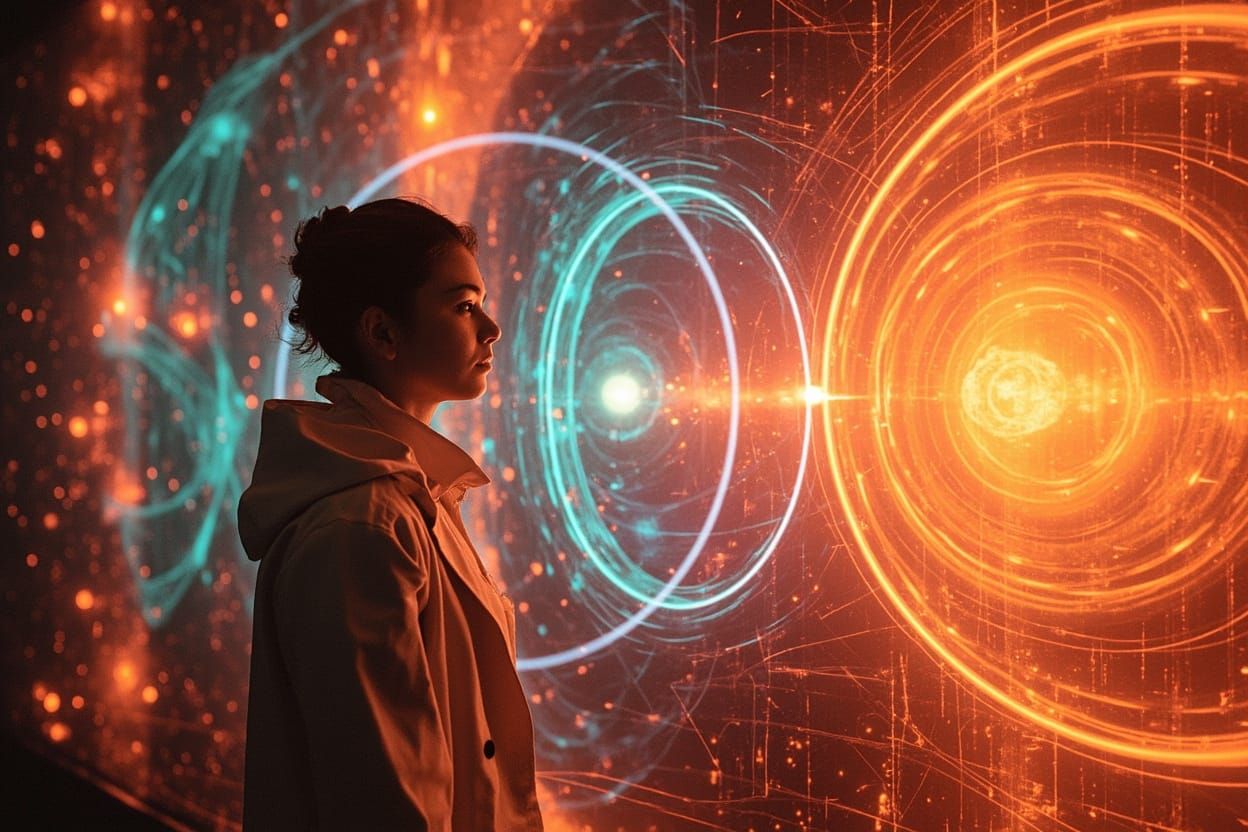
The Echo That Wouldn't Die
Dr. Maya Chen had spent seventeen years studying the quantum foam—the seething substrate of spacetime where reality itself flickered between existence and probability. Her lab on Enceladus, that frozen moon of Saturn, had produced the most sensitive quantum detectors ever built, instruments capable of peering into the whisper-thin membrane that separated our universe from infinite others.
The discovery happened by accident.
Maya had been running a routine calibration sequence when the detectors registered something impossible: a resonance pattern that matched no known quantum field. At first, she assumed it was noise—thermal fluctuations from the Cryobot's nuclear core, perhaps, or interference from Saturn's magnetosphere. But the pattern persisted, and it grew stronger each day.
"It's not noise," her colleague Dr. Yusuf Okafor said, his dark eyes fixed on the readouts. "It's a signal. Something on the other side is... responding to us."
The quantum foam, they soon realized, was not a wall. It was a window.
Over the following months, Maya and Yusuf developed a technique to amplify the resonance, to strengthen the signal. They could now hear whispers from the other side—not words, exactly, but impressions, emotional textures, fragments of thought that bled through the quantum barrier.
The first voice they heard belonged to a version of Maya herself.
"I was seven when my grandmother died," the other Maya said, her consciousness brushing against theirs like a cold hand. "I never told anyone. I cried for three days and then I stopped. I thought that made me strong."
Maya sat in silence for a long time after that transmission ended.
The implications unfolded slowly, like a nightmare revealing itself in stages. The quantum foam was not a single membrane but a confluence of membranes—layers of reality stacked against one another like pages in a book. And they were bleeding into one another.
The effect was subtle at first. People reported déjà vu, vivid dreams of lives they had never lived. A mother in Munich woke screaming, convinced her child had died in a fire that never happened. A soldier in Seoul began receiving medals for battles in a war that existed only in a parallel world. A young girl in Buenos Aires started speaking in languages she had never learned, describing places she had never been.
Then came the mergers.
It started with the scientists—those who had been listening longest, whose minds had been most thoroughly marinated in quantum resonance. Maya felt it first: a sudden doubling of her own thoughts, as if a second voice had taken up residence inside her skull. The intruding consciousness was vast and strange and utterly unfamiliar.
"I am Marcus," it said. "Marcus of Universe Fourteen. I am a construction worker. I pour concrete for a living. I have a daughter named Sofia. She is seven years old and she likes horses."
"Maya," Maya said aloud, though she hadn't meant to speak. "Dr. Maya Chen. I study quantum physics. I have no children. I have no life outside this lab."
For a moment, the two consciousnesses regarded each other across the gulf of worlds.
"This is very strange," Marcus said.
"Yes," Maya agreed. "It is."
The merger was violent. Universe Fourteen Marcus—simple, happy, uncomplicated Marcus, who poured concrete and watched sports and loved his daughter—found himself suddenly flooded with decades of scientific training, memories of experiments he had never conducted, colleagues he had never met, and a consuming guilt over decisions he had never made.
"I didn't ask for this," the composite Marcus would later tell investigators. "I was happy being a guy who poured concrete and watched sports. Now I can't look at a sunset without calculating its photochemical composition. I can't have a conversation without seeing seventeen different versions of how it might end. It's like... like someone gave me the entire universe as a present and then filled it with spiders."
Yusuf's merger was worse.
He had been more heavily exposed, more deeply immersed in the resonance. When the merger came for him, it brought dozens of voices at once—a chorus of Yusefs from a hundred different worlds, each carrying decades of divergent experience.
"I was a poet," one of them said, through Yusuf's trembling lips. "In my world, I never went into science. I wrote novels. No one read them."
"I died of cancer at thirty-four," said another. "I never even applied to the program."
"I became a warlord," whispered a third, and something dark flickered behind Yusuf's eyes that had never been there before.
The Global Science Council convened in emergency session. Maya testified via quantum link, her voice frequently interrupted by the intruding thoughts of Marcus, who had opinions about everything and was not shy about sharing them.
"We are witnessing a fundamental restructuring of consciousness itself," Maya said, as Marcus argued with her about the grammatical structure of her sentences. "The quantum foam is not merely a medium for parallel universes. It is becoming a medium for the exchange of identity. We are not just seeing other realities. We are becoming them."
"And what," asked the Council President, a tired-looking woman from Norway, "do you propose we do about it?"
Maya was quiet for a long time. When she spoke again, it was not entirely her voice.
"We adapt," said Maya and Marcus together. "We evolve. We become something new."
The rejection movement began within weeks. It was led, predictably, by those who had not yet been touched by the resonance—those who still lived in a world of singular identity, of uncomplicated selfhood. They called themselves the Purists, and they wanted the mergers reversed. They wanted the voices silenced. They wanted their universe back.
"We are not asking for much," their leader, a former banker named Gerald Holloway, told the cameras. "We are simply asking to remain ourselves. Is that so terrible? Is that so unreasonable?"
Many agreed with him. Many more were terrified. The idea of sharing one's mind with another consciousness, even a friendly one, even a version of oneself from another world, struck most people as a horror beyond imagining.
But the resonance did not care about fear. It did not pause for debate or deliberation. It simply continued, growing stronger each day, until entire cities were filled with people walking and talking and arguing with themselves.
In the end, it was Maya herself who provided the philosophical framework that allowed the world to accept what was happening.
"We have always believed that identity is singular," she explained in her famous address to the United Nations. "That each of us is one person, contained within one body, inhabiting one life. But this was always an illusion. We are not singular. We never were. We are already plural—plural in time, as the different versions of ourselves that we might have been; plural in space, as the different configurations of matter that we might have occupied. The quantum foam is simply revealing what was always true: that we are one expression of a vast and incomprehensible consciousness that extends beyond the boundaries of any single world."
She paused. Somewhere inside her, Marcus was weeping for his daughter, who existed only in a universe that was slowly merging with their own.
"This is not a curse. It is not a disease to be cured or a problem to be solved. It is the next stage of our evolution. We are becoming what we always had the potential to be: a truly universal consciousness, aware of itself across all possible versions of reality."
The reactions varied, as Maya had known they would. Some celebrated. Some despaired. Some tried to reject the entanglement entirely, severing their connections to their parallel selves through dangerous neural procedures that left them hollow and strange and forever outside the conversation.
But most people, eventually, made peace with the voices. They learned to live with them, to listen to them, to argue with them and laugh with them and love them. They discovered that consciousness, freely shared, was not diminished but amplified—that wisdom, multiplied across worlds, was wiser still.
Years later, Maya would sometimes sit on the observation deck of the Enceladus station, watching Saturn's rings catch the distant sunlight, and listen to the chorus of voices that had become her family.
Marcus was there, of course. And Yusuf, who was now a choir of poets and soldiers and one very tired warlord. And the girl from Buenos Aires, who had become the world's greatest translator, speaking fluently in the languages of a thousand parallel worlds.
"Are you happy?" Marcus asked her one evening, as they watched the rings turn.
Maya considered the question carefully. She had learned to do that now—to hear all sides before answering, to weigh the perspectives of a hundred different versions of herself before speaking.
"I don't know," she admitted. "I'm not sure I know what happiness is anymore. I'm not sure I'm one person enough to feel it the way I used to."
Marcus was quiet for a moment. Then: "I think happiness is bigger now. It has more room. It has more voices singing it."
Maya smiled, and the smile was hers, and also his, and also all the others, stretched across the quantum foam into infinite variations on a single theme.
"Yes," she said. "I think you're right."
And the echo that was all of them continued on, brighter and stranger than any of them had ever imagined.