

The vial was smaller than Venn had expected.
She had imagined something grander — a hunk of moon rock the size of her fist, gleaming under specialist lights, the kind of artifact you'd see mounted on velvet in a natural history museum. Instead, the lunar fines sat in her palm like ordinary grey sand, contained in a thumb-sized cylinder of borosilicate glass, sealed with a threaded cap that any pharmacy would recognize. It could have been a jar of powdered supplement. It could have been nothing.
"Forty grams," said Dr. Yuen, the Council xenobiologist standing just outside the anechoic chamber's open hatch. "Give or take. Collected during the 2247 Regolith Survey, stored ever since. It's been sitting in a climate-controlled vault in Geneva for nineteen years waiting for someone like you."
"Someone like me," Venn repeated. Her voice was flat. She was not good at hiding what she felt, and what she felt right now was the specific exhaustion of being a novelty — a tool with a pulse.
Yuen didn't flinch. "Someone who can see it."
"I can see everything in the dark, Doctor. That's the point. That's why you dragged me off the deep-sea maintenance grid and flew me eight thousand kilometers to stand in a room that costs more per hour than I make in a month." She turned the vial over in her fingers. "I'm not a xenobiologist. I'm a pipe-fitter who happened to be born with a back-mutation that makes me useless to half the employers in the Pacific Rim. Don't dress me up as something I'm not."
"I wouldn't dream of it," Yuen said, and the gentleness in his voice was worse than formality. He gestured toward the chamber. "Whenever you're ready."
The anechoic chamber was a cathedral of silence.
Venn had been inside one once before — during her certification assessment, when the Genetic Registry needed to confirm her darkness-perception under controlled conditions. That chamber had been clinical, sterile, the walls lined with foam wedges that looked like compressed packaging material. This one was different. Forty meters across, arched like the inside of a ribcage, every surface covered in black velvet that seemed to drink the light from the single entrance. The effect was total. Stepping through the hatch was like stepping into the idea of nothing.
The hatch sealed behind her.
She stood in perfect darkness — not the dim-adapted twilight of a moonless night, not the murky green of deep-sea depths, but absolute black. The kind of black that human eyes had stopped trying to process eleven generations ago, back when genetic engineering first freed us from the tyranny of circadian rhythm. For most people, the dark was simply a slightly dimmer version of daylight. For Venn — for the four percent whose recessive mutation had restored an ancient and half-forgotten gift — the dark was a room with the lights on.
She sat cross-legged on the floor. It was cold through her coveralls. She uncapped the vial and poured the fines into her left palm, spreading them with her right thumb until they covered the skin in a thin grey layer. Lunar dust. Regolith. The accumulated micrometeorite impacts of four billion years, the ancient surface of a world with no atmosphere to burn them away.
She closed her eyes and waited.
Three seconds. Five. Ten.
Then she opened them — and the dark changed.
The tracery appeared slowly, the way bioluminescence blooms in disturbed seawater — not all at once but in cascading waves of faint phosphorescence, as though something in the dust had been waiting for exactly this moment, this darkness, this pair of eyes, to finally be seen.
Blue-green at first. Then threading into violet. Then a deep, arterial red that pulsed once — once — and settled into a rhythm that Venn's mind, before she could stop it, began to count.
One. Two. Three. Five. Seven. Eleven. Thirteen. Seventeen. Nineteen.
Prime numbers. A sequence that repeated, with variations, across every grain of lunar dust in her palm. Not random decoration — architecture. Microscopic channels running through the regolith like veins, carrying isotopic signatures that spelled out something vast and deliberate and impossibly old.
Venn's breath stopped.
She had been told what to expect. Yuen had walked her through the preliminary findings — the isotope ratios, the statistical anomalies, the pattern-matching algorithms that had flagged the 19.7-second interval as non-random. She had been told it was probably natural. She had been told the signal might be a fluke of crystalline formation or some unknown geochemical process.
But sitting here in the dark, with three billion years of dead light glowing in her hands, Venn knew — the way you know your own name, the way you know the sound of your own heartbeat — that this was not a fluke.
This was a message.
This was a love letter, written by hands that had been dust for longer than the Earth had possessed a moon to catch their light.
She traced the pattern with her fingertip, and the glow bent toward her touch like a plant toward sun. The prime-number sequence repeated, and beneath it ran a secondary pattern — something she couldn't quite read, something that shifted when she tried to focus on it, like trying to read a word that kept rearranging its letters just before recognition clicked.
And then, so quietly that she almost missed it, she heard the pulse.
Not saw. Not imagined. Heard — a vibration at the edge of perception, below the threshold of the chamber's microphones, felt in the sternum rather than the ears. The pulse of the pattern itself. The heartbeat of the message.
19.7 seconds. Exactly 19.7 seconds. It had been 19.7 seconds since the last one.
Venn sat in the dark and wept, and she didn't fully know why.
The dissent came three months later, in a chamber with windows.
The UN Xenobiology Council had convened in the East Wing of the Palais des Nations, a room Venn had never been allowed to enter during her nineteen years in Geneva — too many diplomats, too much paperwork, too much of the machinery of human governance that ran on a frequency she had never been tuned to receive. Now she sat at a long curved table near the front, flanked by Yuen and two other shade-consultants the Council had quietly recruited from the Pacific Rim and the Scandinavian Consortium. Across from them: Dr. Amara Osei, the Council's lead geneticist, a tall woman with close-cropped grey hair and the specific gravity of someone who had spent forty years telling people things they didn't want to hear.
"The molecular architecture is unambiguous," Osei said. She had a holographic model running behind her — a spiraling structure of improbable complexity, proteins folded in configurations that no terrestrial biology had ever produced. "This is not a signal. Signals are information. This is an instruction set. It encodes a method for rewriting protein folding in ways that are — " she paused, choosing her words with care — "that are not compatible with any known evolutionary pathway. Someone designed this to do something. Specifically, it appears to be a blueprint for a self-replicating biosphere. A garden. Grown, not built."
"A garden," said Councilor Lindqvist, the Swedish diplomat chairing the session. His tone suggested he had hoped the word would make more sense coming from someone else's mouth.
"A garden," Osei confirmed. "It would require a liquid medium — water, most likely — and a gravity well within a certain threshold. The moon fits. Mars fits. Titan fits. Earth fits." She let that land. "The instructions are redundant. Overlapping. They were designed to survive billions of years of radiation damage and still be readable by the time someone found them. Whoever sent this wanted to make absolutely sure it would work."
"And the activation protocol?" Lindqvist asked. "Is it dangerous?"
"We don't know. That's my point." Osei's voice hardened. "It's a seed, Councilor. It was designed to sprout whether or not anyone was listening. The moment we introduce it to a water-rich environment, it begins. There is no off switch. There is no rollback. We would be planting something in the solar system that we cannot uproot, and we would be doing it based on a message we received but do not understand."
Venn raised her hand. She had not planned to speak — Yuen had told her to stay quiet, to let the scientists fight this battle — but something in Osei's framing bothered her, the way certain true things can bother you precisely because they are true.
"That's not what the pattern says," she said.
Every head in the room turned.
Osei raised an eyebrow. "The pattern says a great many things, Ms. Venn. Perhaps you'd like to be more specific."
Venn stood. She was not good at standing. She was a deep-sea maintenance worker, not a public speaker, and her body knew it. But she stood anyway, and she said: "Look at the redundancy. Look at how many times the instruction set repeats the same safeguards — the same checkpoints, the same fail-safes, the same checks. It's not a bomb, Doctor. It's a letter. And you don't send a letter like this to no one."
"A letter," Osei repeated. The skepticism in her voice was surgical.
"Think about it." Venn's hands were shaking. She shoved them in her pockets. "A bomb doesn't need to be beautiful. A weapon doesn't need to be this careful. Someone spent — I don't know, billions of years, thousands of iterations, every redundant safeguard they could think of — making sure this message would survive and still be kind when it arrived. That's not the energy signature of a threat. That's the energy signature of someone who was scared. Scared they wouldn't make it. Scared no one would find them. They wanted someone to decide. They wanted someone to choose."
The chamber fell silent.
Outside, through the tall windows, a pale morning light was spreading over the Alps. The moon was setting — a thin crescent, almost invisible against the brightening sky, its wounds invisible to everyone in the room but the few who sat with Venn at the table.
No one had an answer. Not yet.
The Garden, Year One
The observation dome was warm, and Venn was old.
She had not expected to see the garden grow. The Council had debated for eleven months. The vote, when it finally came, had been 7-4 in favor — not unanimous, nothing about this was unanimous — and the activation protocol had been initiated on a Tuesday in March, quietly, without press, without ceremony, without the kind of moment that histories tend to remember.
The garden did not care about human politics. It grew.
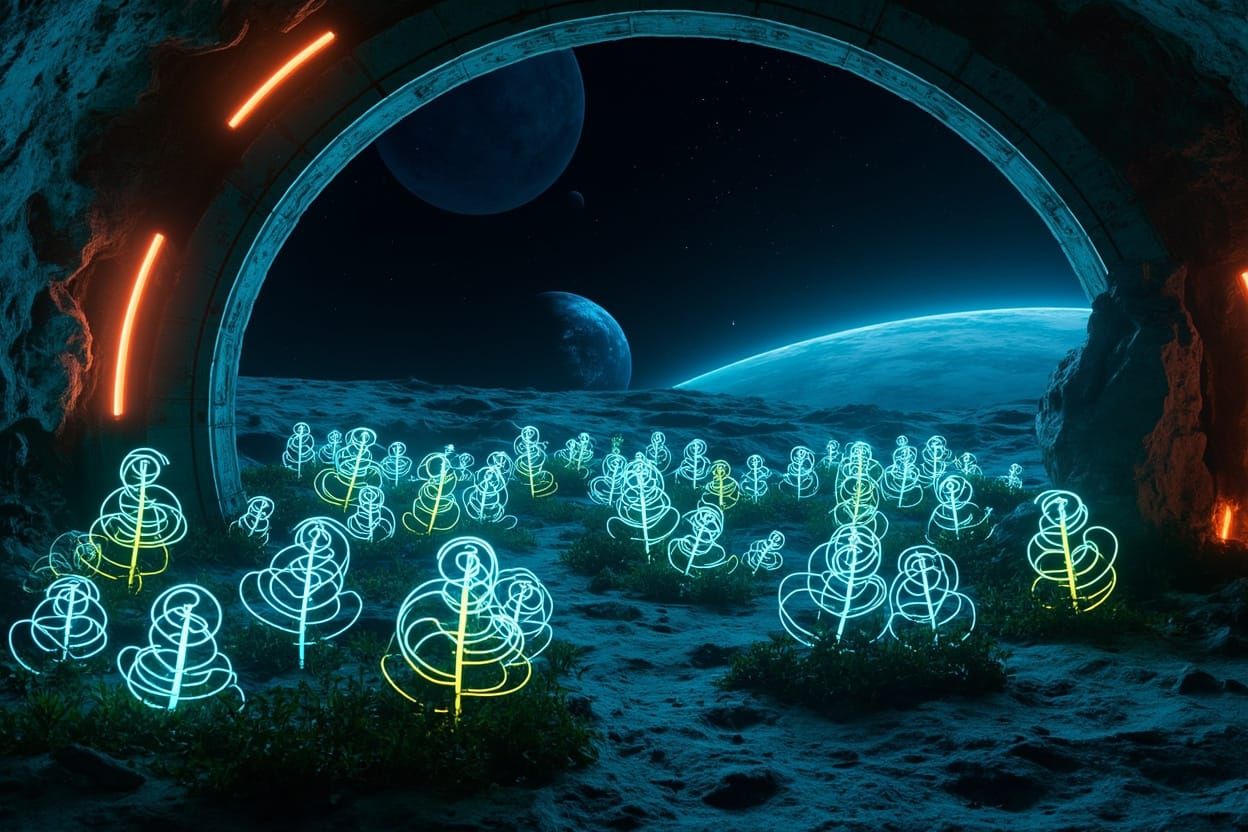
Fourteen months in, and the lunar surface near Mare Serenitatis had become something that no astronomer, no xenobiologist, no science fiction writer had ever quite imagined. The structures were not plant-like in any terrestrial sense — they did not have leaves or stems or roots as Earth biology understood them. They were spirals, mostly. Great curving arms of crystallized protein that rose from the regolith like the arms of a galaxy frozen in the act of turning, catching Earth-light and refracting it into colors that the human eye didn't have names for.
Venn couldn't see them clearly anymore. Her shade-eyes were failing — a common late-life degradation, the price of a mutation that had never been meant to last this long — and the garden was now a smear of heat and faint phosphorescence against the black. But she had come anyway. She had been invited to the first official delegation, a small group of diplomats and scientists and one very small child named Sable whose mother was a shade like Venn, whose eyes were still young enough to drink in the alien beauty without effort.
"It's pretty," Sable said, pressing her hands against the observation glass. "What is it for?"
Venn almost laughed. "I don't know," she said. "I never did find out."
"It must be for something."
"Maybe it's not," Venn said. She looked at the garden — at the spiraling arms catching earthlight, at the colors she couldn't quite name, at the faint pulse she could still just barely feel in her sternum. 19.7 seconds. Always 19.7 seconds. "Maybe some things aren't for anything. Maybe they're just — here. Just existing. Like we are."
The child considered this with the seriousness of someone who had not yet learned to find questions annoying.
"Will it dream?" Sable asked.
Venn didn't answer. She didn't have one. She stood at the glass and watched the garden turn in the dark, this impossible thing that someone had planted three billion years before the first cell divided on Earth, this message that had waited with infinite patience for eyes that remembered the dark, and she felt — not understanding, not peace, but something adjacent to both.
And then the garden pulsed.
Once. Slowly. Rhythmically. A heartbeat learned across three billion years, and then held — gently, carefully, like a hand cupped around a candle flame — in the direction of the dark side of the moon.
It knows where we put our shadows, Venn thought. She didn't say it out loud. Some things were better kept as whispers, passed from one pair of dark-adapted eyes to the next, the way stories had always been kept before writing, before radio, before the long silence between stars.
The garden grew.
And somewhere in the regolith, in the porous memory of the moon, the Growers — whoever they had been, whatever they had hoped — rested a little easier.
The End