

A Fantasy Story
The Shard That Shouted
The first thing I learned about Soulglass: it hums. Not audibly — not to most people — but under the fingers, if your fingers know what to listen for. A frequency that sits just below touch, like the memory of sound. Most of the shards I handled in the low district were quiet. Muted. Background noise from lives that had been ordinary and unremarkable and were now, in their crystallized form, merely trade goods.
This one was not quiet.
I felt it the moment it left the sorting tray — a jolt, a wrongness, like stepping off a cliff you thought wasn't there. My hand closed around it instinctively, the way your hand closes around something hot before your brain registers the burn. The room dimmed. Not literally — the oil lamps didn't flicker, the fog outside didn't shift — but the quality of the light changed, became thicker, older, as if the air itself had been sitting in a jar for a very long time.
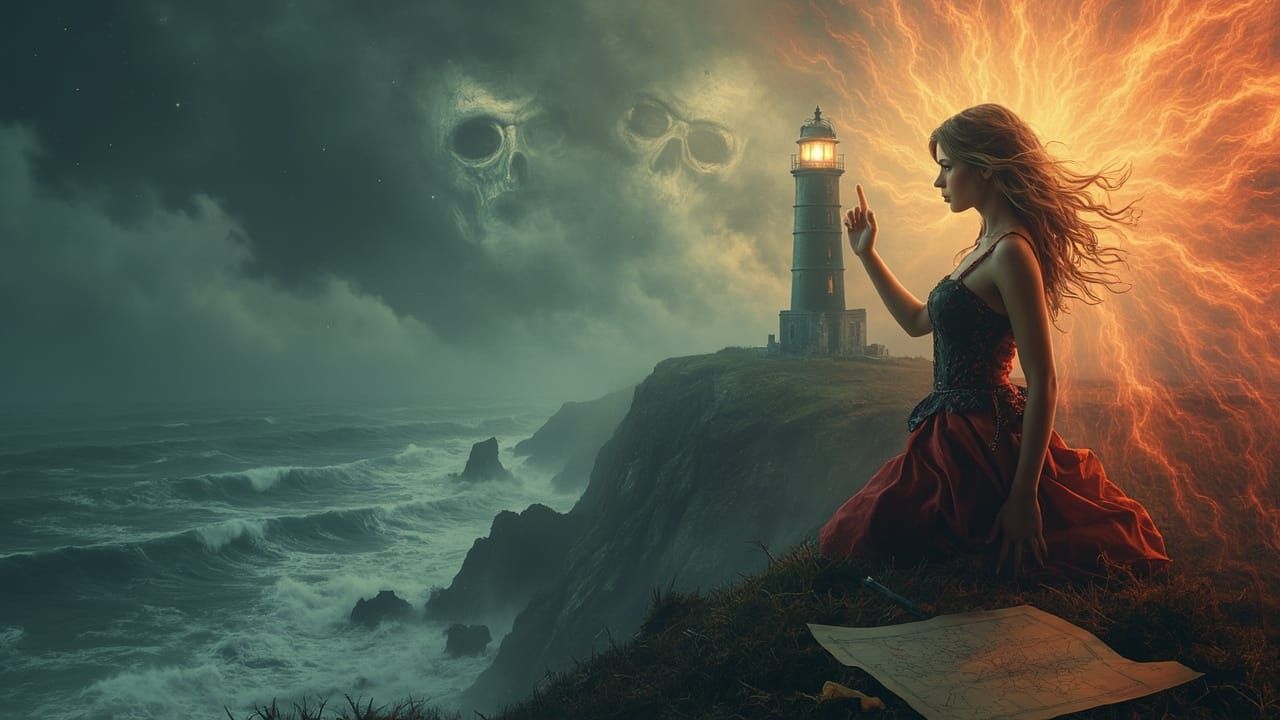
I saw the lighthouse.
Not Thornhallow's lighthouse — I knew that tower the way I knew my own skyline, its beacon sweeping the Greymere in steady arcs every forty seconds. This was a different lighthouse. Older. Built on a spur of black rock at the absolute edge of the world, where the sea ended and the sky began, where the horizon line was not a line but a wound.
And through the wound: smoke. Not fire-smoke. Something else. Something that moved like smoke but thought like weather, that pressed against the gap the way a hand presses against a dam. And in the smoke, faces. Thousands of them. Millions. Faces I didn't recognize and somehow knew — the faces of everyone who had ever loved someone and lost them. Everyone who had ever held a hand in the dark and felt it go cold.
The vision lasted three seconds. Maybe four. Then I was back in the sorting room, kneeling on damp stone, my fingers white around a shard of Soulglass no larger than a walnut, its surface still faintly luminous in my grip.
My colleague, Pell, was watching me from the doorway. "You look like you've seen a ghost."
"I've seen the future," I said. My voice came out strange — thin, like someone else's voice passing through my throat. "Forty years from now. The rift is open. The Dead are through."
Pell laughed. Then stopped when he saw I wasn't laughing.
"That's not possible," he said. "Soulglass shows the past. Everyone knows that."
"Everyone is wrong."
The Council's Silence
The Merchant Council heard me in their upstairs chamber, the one with the windows facing the sea, where the light came in already tired, already gray with distance. Five of them, arranged behind a curved table of dark wood, their faces arranged in expressions of polite skepticism that I had seen a hundred times before, directed at a hundred other low-district workers who had come to them with finds they couldn't explain.
I laid the shard on the table. I told them what I had seen. I did not tell them about the faces — the millions of faces — because I did not have words for what that looked like, for the weight of them, for the specific gravity of collective grief made visible. I said only: catastrophe. The Veilmark lighthouse. Forty years.
Councilor Venn, the eldest, picked up the shard with a cloth. He turned it in the gray light. His expression didn't change.
"You've been working the processing rooms too long, Miss Vane," he said. "Soulglass exposure at your level of sensitivity can cause illusions. We sponsor your mapping work because your talent is useful. We do not sponsor it so you can waste our time with fever dreams."
"The shard is genuine," I said. "Have it tested. The crystallization pattern is from the current century, not—"
"We'll have it tested," Councilor Maren cut in. Her voice was cool, precise. She was the only member I distrusted less than the others — she had a reputation for accurate assessment rather than political positioning. But her expression offered nothing. "In the meantime, you will return to your work. You will not speak of this to anyone. If your findings are genuine, we will investigate discreetly. If they are not, you will have exposed yourself as a liability, and your position here will be reviewed."
It was a dismissal dressed as consideration. I recognized it because I had received variations of it my entire working life: useful enough to employ, not important enough to believe.
I took the shard back. I wrapped it in cloth. I walked home through the fog.
Maren
I found him in the Sailor's Rest, three streets up from the docks, drinking something that was not ale because ale required grain and grain was expensive. He was a large man — tall, broad-shouldered, built like someone who had been taught that the world was a thing to be survived rather than enjoyed. The kind of man who sat with his back to the wall and watched the door.
I had helped him six months before, when he had come to Thornhallow with a shard of Soulglass lodged near his heart. Not in his hand — literally lodged, fused to the tissue, a fragment someone had grafted into him during the Ashveld Campaign, where he had served as a soldier in a war whose purpose he had never understood. The shard held a memory he could not access, that of his younger brother, who had died in that campaign. He wanted to know who the shard had belonged to. I had traced its crystallization signature to a family in the eastern districts, and from there to a woman who had sold it to a field medic in exchange for passage out of the war zone. He had never thanked me. He had paid my fee and left and not come back.
Until now.
"Sit," he said when I walked in. He had already ordered a second cup. He had known I would come.
"The war was about the Veil," I said, sitting. "Someone wanted to tear it open deliberately. The Ashveld campaign — the battles, the casualties — it was cover. Distraction. While everyone was dying on the ground, someone was working on the rift."
Maren looked at me the way he looked at everything: flatly, as if the information were a physical object he was evaluating for weight. "That's a significant claim."
"I know what I saw in the shard."
"You see things in shards that other people can't." He touched his chest, near his collarbone. The shard was still there — I could feel its faint hum even across the table, a lower frequency than the one I had held in the processing room. "I've spent six months trying to access what's in this. I can't. I don't know if it's my brother's memory or someone else's. I don't know if he gave it away or if it was taken. I don't know what my brother thought was more important than being remembered."
"Maybe he thought saving the world was more important than being remembered."
Maren's jaw tightened. "That's not comforting."
"It's not meant to be."
We sat with that. The fog pressed against the windows. Somewhere outside, a bell rang — the harbor watch, marking the hour, marking time the way bells do, as if time were something that could be tracked by its own sound.
"The lighthouse," Maren said finally. "The Veilmark. You think that's where this is going."
"I know it is. The shard showed me."
"Then we go there."
I had not expected agreement. I had expected argument, negotiation, a long process of convincing him that this was worth his time, that it was real, that I wasn't simply another low-district worker with delusions of importance.
"You believe me," I said.
"I don't believe anything. I lost my brother to a war that didn't make sense. If this doesn't make sense either, at least it makes the same kind of sense the war did. Something is wrong with this world. I felt it in the Ashveld. The air was wrong. The way people died was wrong — not like they were being killed, like they were being erased. If your lighthouse is part of that, I want to see it."
He stood. He left coins on the table — too many, enough for both of us and then some. He was already moving toward the door when he said, without turning:
"We leave at dawn. Bring what you need. If this is real, I don't think we're coming back quickly."
The Veilmark
The lighthouse at the edge of the Greymere took three days to reach by coastal path — two days faster than it would have taken by sea, because the sailors refused to go past the second headland, where the fog began to move against the wind and the temperature dropped without warning, and sometimes the water went black in patches that reflected nothing, not sky, not light, not the stars.
The path was narrow and steep and littered with the bones of the world: old shells, older stone, fragments of things that had once been alive and had left evidence of their existence in the way that surviving things always do — by becoming part of the ground they once stood on.
The Veilkeeper met us at the door.
I had expected age. I had expected the weight of years, the stoop and brittleness that comes with time. What I found was a person who looked ageless — not young, not old, but somehow outside of time, as if they had been carved from something that did not participate in the normal process of wearing down. Their eyes were gray. Not the gray of fog or sea or stone — a gray that had no edges, that did not reflect light because it did not need to.
"You've come to seal the rift," they said. Not a question.
"You know why we're here."
"I know why you think you're here. The rift is real. The Veil is thinning. The Dead are pressing against the boundary, and the pressure is growing, and in forty years — or forty days, if the grief of this kingdom continues to compound — the boundary will fail." They looked at me with an expression I couldn't read. "I know this because I have been sealing it. For a very long time. I have given it memories. Many memories. So many that I no longer remember what I have given, and the forgetting is — bearable. Only barely."
"What does it cost?" Maren asked.
"It costs what it costs. You give a memory to the Veil, and the Veil takes it. Permanently. Not misplaced — gone. You reach for it and find nothing. No image, no feeling, no name. The person who lived the moment is still there, technically. But you have no way of knowing what they meant to you. You are lighter. That is the cost."
I looked at the lighthouse. At the black rock it stood on. At the sea beyond, gray and restless, pressing against the horizon the way water presses against a shore — constantly, patiently, without urgency but without end.
"How many memories?" I asked.
"Enough to seal it. Not permanently — nothing is permanent. The Veil is held by hope as well as grief, and hope is a weaker material. But enough to buy time." The Veilkeeper's gray eyes found mine. "You have a talent for reading Soulglass. That means you have a talent for holding memory strongly. You qualify. He does not."
They looked at Maren.
"The shard in his chest is a memory of his brother. It came from a person who loved him and decided that love was worth less than whatever they bought with the trade. He carries someone else's grief. That is not the same as having your own."
Maren said nothing. His hand moved to his chest, to the place where the shard sat fused to his heart.
"How do I begin?" I asked.
The First Memory
The Veil feels like pressure. That was what I had not expected — not a wall, not a membrane, not anything with a visible surface, but a density in the air, a heaviness, as if the atmosphere had been thickened by something that wasn't weather. The Veilkeeper told me to find the thin place — the place where the pressure was greatest — and press my palm against it, and offer it a memory, and let it take.
It was like pressing your hand into water that pushed back.
The first memory I offered was my mother's voice.
I did not choose it deliberately. That is important to understand. You do not select which memory to spend. The Veil reaches into you and finds what fits the wound — and the wound was vast, and the thing that fit it best was the last piece of my mother I had left.
I was eleven when the fever took the rest. Before that day I could still see her face — not clearly, not in full, but enough. A shape. A warmth. The particular way she held her hands when she was thinking, fingers spread, as if she were holding an invisible object and testing its weight. The fever burned the image out, and all that was left was her voice, and her voice had stayed with me for thirteen years like a guest who had overstayed their welcome but who you were grateful for anyway, because the alternative was silence.
Her voice said my name the way she used to say it — not "Senna" but the childhood nickname she had given me, the one no one else used, the one I carried in a small locked room in my chest and only opened when I was alone and the world was too loud.
The Veil took it. I felt it go — not painfully, not with resistance, but with a terrible gentleness, like a hand slipping into your pocket and removing the one thing that mattered and leaving everything else untouched.
I tried to call out to her that night, in my dream, the way I always did — calling her name, waiting for the voice to answer. And I reached into the dark and found nothing. No voice. No warmth. No name. Just the silence where she had been, and the knowledge that I would never know what the silence sounded like again.
I wept. I stopped. I went back to the Veil.
The Second, Third, Fourth
The afternoon I learned to draw maps. That was the second. I gave it to the Veil because the Veil was hungry and because I thought — foolishly — that I could spare it. I had so many other memories. I had my skill, my craft, the thing my hands knew how to do without my mind's permission. I would keep that. I would give away the small things, the incidental ones, the moments that mattered only because they had happened and I had no choice but to carry them.
The afternoon I learned to draw maps: I was sixteen. My teacher — not a formal teacher, just a mapmaker in the district who had let me watch him work — had spread a half-finished coastal survey across his table and pointed at the way the contour lines gathered and dispersed, the way the land told a story in elevation and shadow, and I had understood for the first time that maps were not records of what existed but arguments about it — that a map was a perspective made physical, a way of saying this is how I see the world, and here is the proof.
I gave that away. And discovered afterward that I still loved mapping — still loved it with the same passion I had always felt — but could not remember why. I loved it the way you love a person you have been told to love but have never met. Affection without origin. Devotion without memory.
The third was my first kiss. A boy named Corin. His face was already gone — I had lost that years ago, the way you lose the faces of people you loved but who were no longer alive to remind you of what they looked like. What remained was the feeling: the specific weight of someone's hands on your jaw, the sound of breathing that was also laughter, the electric surprise of being wanted by someone who had the option not to want you.
I gave that to the Veil. And afterward I reached for it and found only smooth, blank space, like a room where the furniture had been removed and the walls repainted and there was no evidence anything had ever happened there at all.
Maren tried to stop me after that. "You've given enough," he said. He was standing at the edge of the lighthouse platform, watching me prepare for the fourth session, his face carved into a expression of helpless fury. "You're emptying yourself. You're giving away everything and you won't even know what you've lost."
"That's the point," I said. "If I knew, I couldn't do it."
The Fifth, Sixth, Seventh
The smell of my childhood home. The specific combination of woodsmoke and salt and the particular variety of flower that grew in the window box — I couldn't name it anymore, I realized, even before I gave it away. I had been losing the smell for years, replacing it with other smells, other associations, until the original was just a shadow of a shadow. The Veil took even the shadow.
The grief over my mother. This was the cruelest one, and I knew it was cruel before I offered it, but the Veil was wide open and hungry and the rift had not closed yet, and grief was the material the Veil was made of, and so I gave it the grief, and I felt something release in my chest — a knot I had carried so long I had forgotten it was a knot and not a part of me — and afterward I was not sad. I was not anything. I was a person standing in a lighthouse at the edge of the world and I felt nothing about any of it, which was probably appropriate, because what was there to feel? I had no memories left to feel anything about.
Maren's brother's shard. He gave it to me. He took it from his own chest — the surgical process must have been agonizing, because the shard had been fused to tissue, to bone, to whatever the war medic had grafted it into. He pressed it into my hand and said, "Use it. Finish it." And I looked at him and said, "This will erase your brother permanently. Not just from the world. From you." And he said, "He already erased himself when he gave it away. I'm just returning what was his."
I used it. The memory of two boys building a sand castle. A summer afternoon. No words, no drama — just hands and sand and the slow, patient work of making something that would be destroyed by the tide and was never meant to last. It sealed another inch of the rift. Maren watched and said nothing.
The Last
The Veilkeeper told me I could stop. The rift was nearly closed. The Veil would hold — not forever, nothing held forever, but long enough. Years. Decades. Long enough for someone else to come, or for the world to find another way, or for nothing to change and everything to collapse slowly instead of all at once.
I reached for the final memory. The one I thought I would give.
I couldn't find it.
I reached again. I searched the rooms of my mind — the rooms I had not yet opened, the corridors I had not yet walked down, the locked doors I had been saving for last. And I found, with the slow dawning horror of someone discovering an empty room they had been told was full: I had already spent it.
I had given away the memory of why I started mapping. I had spent it without knowing, without choosing, at some point in the process when the boundaries between one memory and the next had blurred and I had offered something I didn't know I had. And now I did not know why I drew maps. I did not know what had made me love the craft. I knew only that I did love it, that my hands still moved the way they had always moved, that the maps I made were still beautiful and accurate and full of places that told stories about how the land remembered itself.
I knew only that I loved it, and I didn't know why, and that was — I discovered — bearable. More than bearable. It was a kind of freedom. To love something without needing to remember why is to love it without conditions, without history, without the leverage of your own past. Pure love. Pointless love. Love that asked nothing and therefore could not be betrayed.
The rift sealed.
I felt it close — not with a sound but with a release, a sudden absence of pressure, the way you feel the moment a headache breaks and the world goes soft again. The Veil was whole. The Dead receded. The faces in the smoke withdrew to wherever they had come from, and the boundary between the living world and whatever lay beyond was restored.
The New Cartography
I woke in the lighthouse. The light was gray — dawn, or dusk, I couldn't tell. Maren was sitting in a chair by the door, watching me. He had not left. He had stayed for the entire time — three days, four days, I wasn't sure how long it had been — sitting in that chair, watching me give myself away.
He had no idea what to say to me. I could see it in his face. He was a man who had lost his brother twice, once to death and once to the knowledge that his brother had chosen to be forgotten, and now he was sitting next to a woman who had lost so much of herself she didn't know what was left, and he had no language for any of it.
I picked up a pen.
I did not know why. My hand simply moved. I found a piece of paper — old, slightly damp, covered in the Veilkeeper's handwriting, coordinates and measurements I couldn't interpret — and I turned it over, and I began to draw.
The lighthouse. The cliffs. The fog. The precise angle of the black rock against the gray sea. I drew it the way I always drew — carefully,observantly, with the understanding that a map was not a record of what existed but an argument about it. I drew the lighthouse at the edge of the world, and I drew the paths that led to it, and I drew the paths that would be taken after I was gone, by people who would never know what it had cost to keep those paths open.
I did not sign it. I did not know my name. Not my real name — not the one I had been born with, not the one my mother had used. The name was gone. All that was left was the title, the one I had given myself through years of work: cartographer. Mapmaker. Someone who draws the shape of the world in the hope that someone else will read it and understand.
Maren looked at the map. He looked at me. He looked back at the map.
"Is this real?" he asked. "This place. The city you drew at the bottom of the cliffs."
I looked at it. I had drawn a city I did not recognize — Thornhallow, technically, or what Thornhallow would become, or what it had once been, or what it was in some other version of the world where the rift had opened and the Dead had walked and everything had been different. I had drawn it from somewhere deep and nameless. From a place my conscious mind could not reach.
"I don't know," I said. "But my hands did."
I set down the pen. The map lay between us on the damp stone floor, ink still wet, edges curling. Somewhere outside, the fog was lifting — not clearing, exactly, but changing its mind, deciding to be somewhere else for a while, the way fog does, the way grief does, the way all the things we carry eventually decide to put themselves down.
I had given everything away. My mother's voice. My first kiss. The reason I drew. The smell of the place where I grew up. The afternoon I learned what maps could be. The grief I had carried so long I thought it was load-bearing.
And I was still here. Still sitting. Still breathing. Still drawing cities I had never seen from memories I no longer possessed. Still Senna, minus the parts that made Senna — which apparently left enough to keep drawing, keep noticing, keep being the particular person my hands remembered how to be even when my mind had forgotten.
The Veilkeeper appeared in the doorway. They looked at the map. They looked at me.
"You are what your memories made you do," they said. "Not what they told you."
They left. The door stayed open. The fog rolled in, carrying the smell of salt and something else — something I didn't recognize and couldn't name, something that might have been the smell of my childhood home or might have been the smell of the sea or might have been nothing at all.
I picked up the pen again.
There was more to draw.
End