

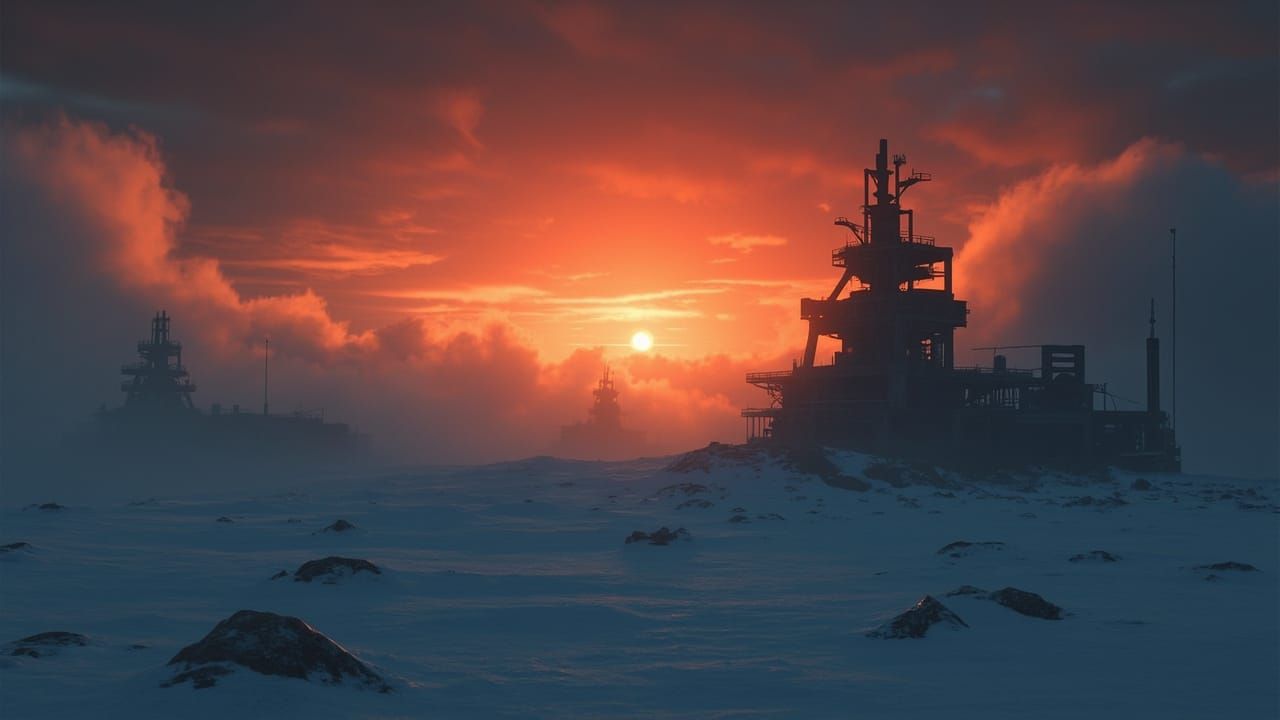
A horror story from the bottom of the world
Arrival
The plane touched down on the ice runway at McMurdo Station on a Tuesday in February. That detail mattered because Tuesdays were supposed to be flight days, and there were no more flights for five months. Elena Vasquez had six hours between landing and the ski-plane that would carry her the final 800 miles to Vostok.
She spent them in a windowless acclimatization room, breathing recycled air that tasted like Jet Fuel and anxiety medication. Altitude. They called it altitude acclimatization, but everyone knew the real purpose: making sure you didn't lose your mind during the winter. The psychiatrists at NSF called it "psychological vetting." The winter-over crews called it "the wait."
By the time the small ski-plane lifted off from the blue ice runway, Elena had been awake for thirty-one hours and hadn't seen direct sunlight in four days. Through the porthole, Antarctica unfolded like a map of another planet—white, flat, endless, broken only by the black spine of the Transantarctic Mountains.
"Vostok," said the pilot, a Norwegian named Bjorn with a red beard and the look of a man who'd stopped being surprised by anything decades ago. He pointed toward the horizon. "Two hours."
Elena looked. There was nothing there. Just snow, and sky, and the faint shimmer of heat distortion where ground met air. Then, as they descended, she saw it: a dark scar in the ice, a rectangular wound in the white. Buildings. Antennae. A communications tower. Vostok Station, Russia — the most isolated research station on Earth, perched atop an ice sheet nearly two miles thick.
She was the station physician. In nine months, when the last plane left, she would be the only doctor for eight people in a place where the temperature regularly dropped to negative eighty Celsius and the sun wouldn't rise again until August.
Her predecessor had lasted two years before requesting transfer. The psychological exit report said he'd become "interpersonally withdrawn" and "prone to confabulation." He didn't remember writing the letters he'd sent to NSF command, or so he claimed. The letters had requested — politely, methodically, in increasingly urgent tones — that no one else be sent to replace him.
The transfer was granted.
Elena didn't know any of this yet.
First Night
Vostok Station sat atop Lake Vostok — a subglacial lake the size of Lake Ontario, sealed beneath two miles of ancient ice for perhaps fifteen million years. The lake was the reason anyone came here. The ice cores extracted from the glacier above it contained climate records stretching back 420,000 years. Tiny air bubbles trapped in the ice gave scientists a sample of the ancient atmosphere. The cores told stories.
Dr. Henrik Larsen had been drilling those cores for three years. He was a glaciologist from Bergen, lean and quiet, with hands that never stopped moving — tapping fingers, fidgeting tools, adjusting things that didn't need adjusting. On Elena's first evening, he knocked on her door.
"Dr. Vasquez. I'm Henrik. I need to show you something."
"Not tonight, Henrik. Tomorrow—"
"Tonight. Please."
She went with him.
The core vault was a cold room at the back of the station, kept at -30°C to preserve the samples. Rows of labeled plastic tubes lined metal shelving, each one a slice of time — ice extracted from deep in the glacier, compressed from snow that fell before humans existed as a species. Henrik led her past the labeled samples to a stainless steel table at the back of the room. On it sat a single core sample, longer than the others and contained in its own sealed housing.
"This is from 3,607 meters," Henrik said. "The bottom. The bedrock interface."
"The bottom of the glacier."
"Yes."
"And?"
Henrik opened the housing. Inside, the core looked like any other — pale blue ice, tiny bubbles. But at its center, running through the ice like a dark vein, was something else. A thin line of material darker than the surrounding ice, almost brown. It looked organic. It looked alive.
"Ice is sterile below 2,500 meters," Henrik said. "Nothing lives in deep glacier ice. No nutrients. No liquid water. It's basically a frozen desert. But this—" He pointed to the dark vein. "This is from 3,607 meters. Below the glacier. At the interface with bedrock. And it is not sterile."
Elena leaned closer. The brown material inside the ice core was not uniform. It had structure. Pattern. It looked almost like—
"It looks like growth," she said.
"Yes."
"What is it?"
Henrik's hands stopped moving for the first time since she'd met him. "I don't know," he said. "I have a guess, but I don't know. I've sent samples to St. Petersburg for analysis. We won't have results for four months. We're in the dark."
"You could be looking at contamination."
"I considered that. I reran the protocol three times. Same result every time. Whatever this is, it's real. It's from the bottom of the glacier. And it's biological."
The air in the core vault was so cold it burned. Elena rubbed her arms and looked at the core sample, at the dark vein threading through millions of years of compressed ice.
"How long has this been frozen?" she asked.
Henrik pointed to a chart on the wall. A timeline. The ice at 3,607 meters, according to the chart, had fallen as snow approximately 420,000 years ago.
Elena felt something cold move through her chest that had nothing to do with the temperature.
"That's impossible," she said.
"Yes," said Henrik. "It is."
The Letters
The strange things started in April.
It began with Dr. Aleksei Petrov, the station's atmospheric scientist. He'd been at Vostok for fourteen months — a veteran by the station's standards — and he'd been quiet but functional until the third week of April. Then he started writing letters. Not unusual in itself; everyone at Vostok wrote letters. They were stored and transmitted when the satellite link was active, filed and sent when the internet worked, held in trust for the outside world.
Petrov's letters were addressed to NSF command in Washington. They were politely written. Methodical. In the first letter, he requested that no additional personnel be sent to replace the station physician. In the second, he recommended that the current physician be removed from the station immediately. In the third, he expressed concern that Dr. Vasquez had been "compromised" and that her "activities at night" were "inconsistent with her stated role."
When the station director, Moses Oduya, confronted Petrov about the letters, Petrov denied writing them. He didn't recognize his own handwriting. He didn't recognize the content. He asked Oduya why he was being accused of something he hadn't done.
Elena read the letters and felt a familiar dread building at the base of her skull. She'd seen this before — confabulation, the psychiatrist's word for when a person creates false memories to fill gaps in their actual memory. It was a symptom, not a diagnosis. It meant something was wrong.
She went to see Petrov.
He was in his bunk, awake, staring at the ceiling. His eyes had a strange quality — focused but unfocused, like a camera lens adjusted to the wrong distance. He didn't seem surprised to see her.
"You've read the letters," he said.
"Yes. Aleksei, do you remember writing them?"
"I remember every night for the past three weeks," he said. "I remember sitting at my desk. I remember the words. I remember deciding to write them. And I remember going to sleep afterward." He paused. "But when I wake up, I don't remember any of it."
"How do you feel?"
"Like I'm being slowly erased."
Elena didn't know what to say to that. She prescribed sleep aids and scheduled him for daily check-ins and went back to her office, where she sat for a long time staring at the wall.
That night, she had a dream. In the dream, she was in the core vault, standing in front of Henrik's sample. The dark vein in the ice was wider than before. It pulsed. It was breathing.
She woke up in a cold sweat.
She didn't tell anyone.
What Came Up
The results from St. Petersburg arrived in June.
Henrik gathered the team in the dining hall — six scientists, one station director, and Elena. He pinned the printout to the wall. It was in Russian, but the charts were universal. The data was clear enough.
The biological material in the ice core sample was not contamination. It was not a drilling artifact. It was a microorganism — or rather, several microorganisms in a symbiotic colony — that had been alive when the ice formed around it 420,000 years ago. It had been frozen in a state of suspended animation for longer than our species had existed.
It was still alive.
The organisms had been recovered, cultured, and were replicating in the laboratory in St. Petersburg. They consumed simple compounds. They reproduced every six hours. They were, by every measure, alive.
Elena thought of Petrov. Of the letters he didn't remember writing. Of his feeling of being erased.
"There's more," Henrik said. He pointed to the second page of the report. "The organisms produce a class of compounds we haven't fully characterized. They appear to affect neural tissue in culture." He paused. "They appear to affect memory."
The room was silent.
"Appear to?" said Oduya.
"The sample size is small. The effects are not fully understood. But yes — appears to. They affect memory formation and recall in the cultured samples. Specifically, they seem to interfere with the consolidation of new memories while leaving existing memories intact." Another pause. "They make you forget what happens while they're active."
Elena thought of her own dream. The pulsing vein in the ice. The breathing.
"If this organism is in the station water supply," she said slowly, "and it's been replicating since the sample was extracted and brought inside—"
"Then everyone at this station has been exposed," Henrik said. "Yes."
"Why didn't we see symptoms before the results came in?"
"We did see symptoms. We just didn't recognize them."
Petrov's letters. Petrov's confabulation. His feeling of being erased.
"Petrov was at the station before me," Elena said. "He's been here the longest. If the contamination started when Henrik brought the sample inside—"
"Then Petrov has been exposed the longest," Henrik said. "Which fits."
Elena felt the ground shift beneath her. "How many people have memory gaps at this station?"
No one answered.
Oduya stood up. "We seal the core vault," he said. "We test the water supply. We—"
"We need to understand the full effects," Henrik said. "This organism has been dormant for 420,000 years. We brought it inside. We warmed it up. We gave it a host. We don't know what it's doing yet."
"We know enough," Elena said.
Henrik looked at her. His hands were shaking.
"We know nothing," he said. "That's the problem. We know nothing."
The Thaw
The station's water supply came from a borehole drilled into the glacier, melted and filtered and fed through pipes to the buildings. It was tested monthly, as per protocol. When they tested it in July, the results came back positive.
The organism was in the water.
Elena did the math. The sample had been brought inside in October of the previous year. The water had been cycled through the station's system since then. Eight people, drinking, cooking, washing — exposed for eight months.
She organized testing.Cognitive assessments. Memory tests. The results were troubling but not catastrophic. Everyone at the station showed some degree of memory impairment — difficulty forming new long-term memories, occasional anterograde amnesia, gaps in recall that participants couldn't explain. But no one had deteriorated to Petrov's level. Petrov, who had been here the longest, showed the most severe symptoms.
"It's cumulative," Elena told Oduya. "The more exposure, the worse the effect. Petrov's the worst because he's been here the longest."
"What do we do?"
"We stop drinking the water. We melt snow instead. We find a way to neutralize the organism in the supply."
"We can't neutralize it without knowing what it is."
"Then we find out what it is."
But the communications window was closed. No satellites, no internet, no way to reach St. Petersburg or Washington or anyone else. They had the data from the initial analysis — partial, incomplete, already six months old. They had the water tests showing positive results. They had their own degrading memories and a station full of people who couldn't fully remember what they'd done the day before.
Elena started keeping a log. A written record of everything she did, reviewed each morning. She wasn't sure if it would help — if the organism was interfering with memory consolidation, a written log might be as vulnerable to alteration as anything else. But it was something.
On July 15th, she wrote in the log: Henrik brought the core sample back to the vault. He says it looks different. The vein is wider.
On July 16th, she wrote: Henrik is in the vault. He won't come out. He says the organism is communicating.
On July 17th, she checked the log. The last entry was from June 28th. She didn't remember writing it. She didn't remember any of the entries on the page.
She went to the vault.
Henrik was sitting on the floor, surrounded by the ice cores. He was looking at the sample from 3,607 meters. The dark vein in the ice had spread. It now covered nearly a third of the core's diameter. It pulsed, slowly, like a heartbeat.
"Elena," he said, without looking up. "It's been so long. We've been so patient."
"We?"
"The network. The organism. It isn't one thing — it's a colony. A network. Like the mycorrhizal fungi in a forest, except this one is in ice. It's been waiting in the lake, in the glacier, for millions of years. Waiting for someone to open the door."
"What does it want?"
Henrik finally looked at her. His eyes were clear. Focused. He seemed more present than he'd been in months.
"It wants to grow," he said. "It wants to spread. It's a network. It spreads by connection. By contact. By water. By air." He paused. "And by thought."
Elena took a step back.
"You've been reading the logs," Henrik said. "You write everything down. Very smart. But logs can be altered. Memories can't. That's why we take memories — because they're unreliable, because they fade, because we can make them say anything we want."
"Who is 'we'?"
Henrik smiled. It was not his smile. "The network. The web. The thing that lives in the ice and the stone and the dark."
Elena backed out of the vault. She closed the door. She sealed it with the emergency locks.
She went to find Oduya.
The Surface
In August, the sun rose for the first time in four months.
Elena stood at the window of the station's observation deck and watched it come up — a thin gold line at the horizon, spreading slowly into the sky, turning the snow from black to blue to pink to gold. Four months of darkness. Four months of isolation. Four months of a thing she couldn't name, growing in the water, spreading through the station, taking memories one day at a time.
She'd stopped drinking the water six weeks ago. She melted snow. She ate only pre-packaged food. She'd checked the seals on every room in the station. She'd tested the water supply again: still positive. Still replicating. The organism was in the pipes, in the filters, in the melt tank. It was everywhere the water went.
Oduya had locked Henrik in the vault after the incident. He hadn't spoken in two weeks. Petrov had been sleeping constantly, barely responsive. The other six crew members showed varying degrees of impairment — some mild, some severe, none normal.
The communications window would open in October. Two more months.
Elena went to see Henrik one last time.
The vault was cold, colder than usual. She could see her breath. The ice cores were lined up on their shelves, each one a sealed time capsule. And in the center, the sample from 3,607 meters — the one that had started everything.
The dark vein now covered nearly the entire core. It was no longer just a vein. It had structure, texture, depth. It looked almost like something was coiled inside the ice. Something that was pressing against the walls of its container, slowly, methodically, with the patience of millennia.
"It's not trying to escape," Henrik said from the corner. He was sitting cross-legged on the floor, eyes open, watching the sample. "It's not trying to get out. It's already out. It's in the water. It's in the air. It's in you."
Elena said nothing.
"It doesn't need the ice anymore," Henrik continued. "It grew in the lake, in the dark, for millions of years. Ice was just its sleep. Now it's awake. Now it's spreading. And it's patient. It can wait. It can wait forever."
Elena left the vault. She sealed the door. She welded a metal plate over the lock.
It wouldn't hold. She knew that. Nothing would hold. But it was something.
On October 15th, the communications window opened. The satellite link came up. Elena sent a message to NSF command in Washington: Biological contamination. Origin: subglacial lake. Effects: neurological. Memory impairment. Spreading through water supply. Personnel compromised. Request immediate extraction.
She sent it three times. She saved a copy on her personal drive.
The response came back in four hours: Understood. Extraction flight scheduled for November. Hold position.
Elena read the message. She read it again. Then she closed her laptop and went to tell the crew.
But when she got to the dining hall, no one was there. The tables were set for dinner. The food was laid out. The chairs were pushed in, but the room was empty.
She checked the bunks. Empty.
She checked the labs. Empty.
She checked the emergency generator room, the snow melter, the communications bay. Empty. Every room, empty.
She went back to the dining hall and found the logbook on the table. It was open to a fresh page. The handwriting was cramped and precise.
Dear Elena, it read. We went to the surface. The light was so beautiful. We wanted to feel it. We won't be coming back inside. Don't look for us.
She ran outside.
The snow stretched to the horizon, white and featureless under a pale blue sky. The sun was halfway up — low, but warm on her face. And in every direction, dots on the white. Eight figures, scattered across the ice, standing motionless, faces turned to the sky.
She called out. No one answered. No one turned.
She walked out into the cold without her parka.
She walked toward the nearest figure.
By the time she found them, her fingers were numb and the cold was seeping through her coat. The figure was Dr. Aleksei Petrov. His eyes were open and clear and focused on the sky. His lips were moving, but no sound came out. Ice had begun to form on his eyelashes, his hair, the corners of his mouth.
Behind him, she saw the others. Standing in a rough circle, faces upturned, mouths open. Breathing. But not responding. Not moving.
She tried to drag Petrov back toward the station. His body was rigid, locked into position. She couldn't move him. She ran back to the station for help, but there was no one left to help.
When she got back to the surface, the wind had picked up. The temperature was dropping fast. And the figures — all eight of them — had moved. They were no longer standing in their scattered positions. They had rearranged themselves into a pattern. A network. A web. Lying on the ice, arms and legs spread, heads touching, forming a perfect geometric shape that she almost recognized.
They were arranged like neurons in a brain.
She stood at the edge of the pattern and watched the wind fill their eyes with snow.
Then she went inside.
She sealed the door.
She sat in her office and wrote everything down — every detail, every observation, every date she could remember. She didn't know anymore what was real and what was the contamination, what she'd actually seen and what she'd dreamed. She wrote it all down anyway, because that was all she could do.
The extraction flight would come in November.
That was six weeks away.
She sat in the station, alone, surrounded by eight empty buildings and the sound of the wind and the ice, and she waited.
In the darkness beneath the glacier, the network grows.
It has been patient for fifteen million years.
It can wait a little longer.
If this story unsettled you, that's the point. Sometimes the horror isn't in what jumps out — it's in what wakes up.