

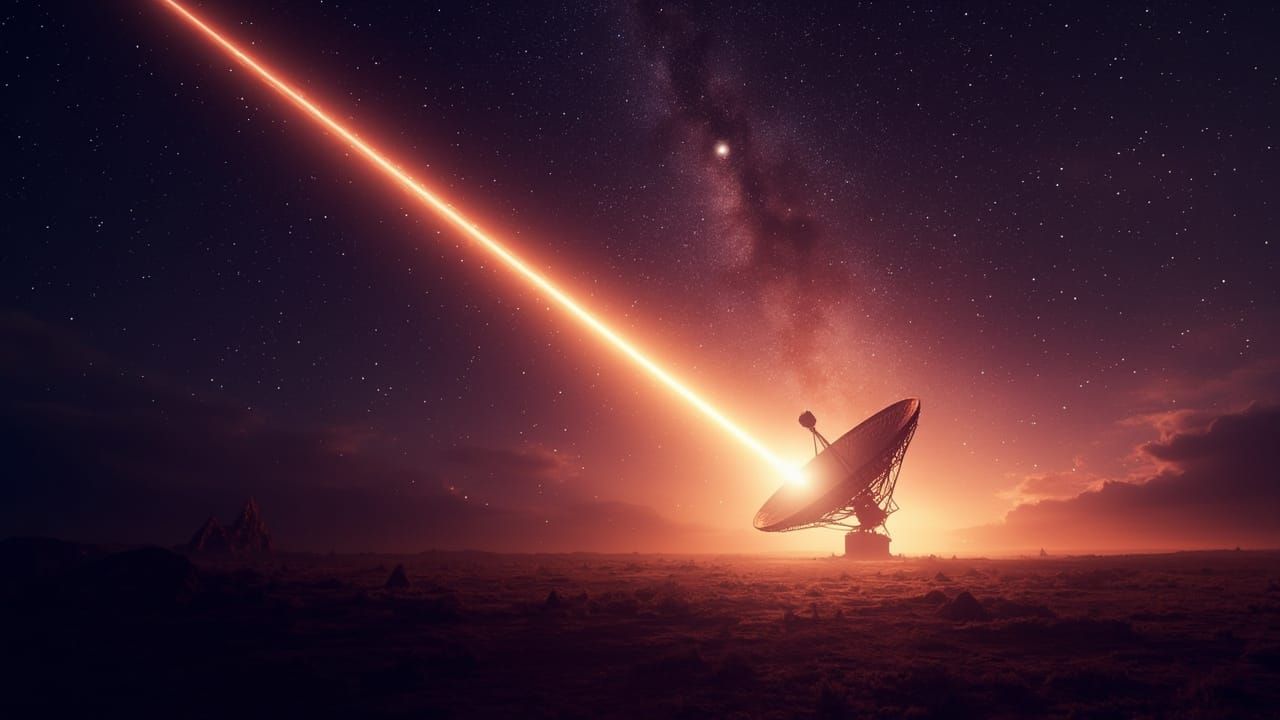
The Last Signal from Kepler-442b
The Signal
The first time Dr. Yuna Okafor heard the Kepler signal, she thought it was radio interference from the solar storm two days prior. She was three coffees deep into her overnight shift at the Arecibo II Observatory, scrolling through noise floor data on a Tuesday morning that refused to become interesting.
Then the pattern repeated. And repeated again.
She sat up straighter. Her chair creaked in protest.
The signal wasn't random. It wasn't satellite chatter or aircraft navigation beacons or the usual symphony of human-made electromagnetic chaos that polluted the skies. It had structure. It had rhythm. And most unsettling of all, it was coming from Kepler-442b — a rocky exoplanet 112 light-years away in the constellation Lyra, right in the middle of its star's habitable zone.
Yuna pulled off her glasses and cleaned them, then put them back on, as if the lenses themselves were the problem. She was not an optimistic woman. Her colleagues called her "The Pessimist" with a kind of affectionate resignation. She had written three papers on why we'd never detect intelligent extraterrestrial life and had won a minor award for the most-cited paper in astrobiology that year.
She picked up the phone and called Director Chen before the signal stopped.
The Frequency
Within six hours, the signal had been confirmed by three independent observatories: the Very Large Array in New Mexico, the MeerKAT array in South Africa, and the Five-hundred-meter Aperture Spherical Telescope in China. The international media caught wind of it within twelve. By the time Yuna finished her third shift in a row, the hashtag #KeplerSignal was trending in 94 countries, and her inbox contained 847 unanswered emails.
But here was the thing that kept Yuna up at night — the thing that no press release would fully explain — the signal wasn't just structured. It was escalating.
What started as a repeating 7-pulse burst on day one had evolved. By day three, it was 11 pulses. By day five, 13. The mathematical sequence was unmistakable to anyone who bothered to look: prime numbers. 2, 3, 5, 7, 11, 13...
And then it stopped.
The silence from Kepler-442b was somehow worse than the signal itself.
The Message
On day seven, a team of linguists and mathematicians at SETI published their preliminary analysis. The signal, they concluded, was almost certainly artificial. Not just that — it appeared to be a deliberate attempt at contact, using prime number pulses as a universal "hello." A cosmic doorbell.
But the real revelation came from Dr. Amir Hassan, a cryptographer at MIT who had been pulled into the analysis. Buried beneath the prime number sequence, he found a secondary frequency — a low, almost imperceptible carrier wave that contained encoded data.
It took eleven days to decode the first frame.
What they found was a diagram. Simple. Geometric. A circle with a smaller circle inside it, and three lines radiating outward.
A sun. A planet. And something that might have been a spacecraft. Or a being. Or a message.
"This isn't first contact," Yuna said at the emergency briefing, her voice flat. "This is a reply. Someone knew we were listening."
The room went quiet.
"We have no evidence—"
"They sent us a map, Amir. They built it to be decoded by a civilization that uses radio waves. They knew we'd be listening. They knew we'd hear. That's not a hello. That's an answer to a question we didn't know we'd asked."
The Distance
Here was the cruel math that kept Yuna functional, if not sane: Kepler-442b was 112 light-years away. Whatever had sent the signal had transmitted it 112 years before Yuna was born. If she replied today, a response would arrive 224 years from now — assuming whatever had sent the original signal was still there, still listening, still there.
She wasn't talking to an alien civilization. She was talking to a ghost. A light echo from a world that might already be dead, or evolved, or empty.
But the message had changed everything anyway.
Because now they knew. They weren't alone.
The Decision
The United Nations convened an emergency session. Philosophers were dragged onto cable news. The Pope issued a statement. In South Korea, a man shaved his head and painted his body silver, declaring himself an ambassador to the stars. In Texas, three different churches began holding midnight vigils.
And in a small conference room in Puerto Rico, Yuna Okafor sat across from Director Chen and told him exactly what she thought they should do.
"We respond," she said. "With math. With science. With everything we have. We send them the sum of human knowledge — our history, our biology, our mathematics, our art. We send them Bach and Beyoncé. We send them the structure of DNA and the periodic table and the complete works of Shakespeare."
"And if they respond again?"
"Then we learn how to wait. And we learn how to hope. And we accept that the conversation might take a thousand years to have, but that doesn't mean we shouldn't start it."
Chen looked at her for a long moment. "You're not the pessimist I hired."
"The pessimist was wrong," Yuna said. "I've made my peace with that. Now I just want to know if anyone is out there listening."
The Transmission
On day thirty, they sent it.
A massive, focused radio burst aimed at Kepler-442b, carrying a compressed packet of human civilization. It would take 112 years to arrive. It would take 224 years to get a reply, if one ever came.
The world's newspapers covered it with a mixture of wonder and exhaustion. The stock market hiccupped and recovered. A famous actor live-tweeted the transmission with commentary that was equal parts sincere and ironic. By midnight, it was no longer trending.
Yuna stayed at the observatory, though. She watched the data streams, the noise floor, the same patterns she'd stared at a thousand times before. She wasn't expecting a response. Not for centuries. She wasn't even sure what she was hoping for.
Then, just before dawn, a junior analyst burst through the door.
"Dr. Okafor — there's something else. A new signal. Different frequency. Coming from the same system."
Yuna's coffee cup froze halfway to her lips.
"What kind of signal?"
The analyst's face was pale. "It looks like... it looks like a confirmation. Like an acknowledgment. And underneath it — another prime sequence. The next one in the pattern. 17."
The cup fell. It shattered on the floor. Yuna didn't notice.
Somewhere in the dark between stars, 112 light-years away, something was listening. Something had heard. And in the time it took for light to cross the void — in the time it took for human civilization to take its first wobbly steps into the cosmic conversation — it had already said hello back.
The Story That Didn't End
Yuna Okafor never left the observatory. She died there, eighteen years later, still listening, still waiting, still believing. Her ashes were scattered beneath the great dish, and her name was eventually given to the first interstellar probe humanity ever launched — a tiny vessel carrying her words, her photographs, and a simple message that would outlast every human institution that had ever named it.
In her final journal entry, she wrote only this:
We are not alone. We knew it before the signal. We were afraid to say it. Now we've said it, and the universe has said it back, and neither of us can take it back, and that is the most beautiful thing I have ever known.
The signal from Kepler-442b continued for six more years — then stopped. It resumed again, seventy-three years later. It had been doing this, observers eventually realized, for a very long time. Before humanity learned to listen. After humanity learned to speak.
Waiting.
Answering.
And somewhere in that long silence between the stars, the conversation continued. Patient. Endless. Unbearably, impossibly alive.
END